


Quick Answer: A quartz movement watch uses electronic oscillator regulated by quartz crystal to keep time. The crystal vibrates at precise 32,768 Hz frequency, providing accuracy within ±15 seconds monthly versus mechanical watches' ±20-30 seconds daily drift. Battery powers the system (2-5 years typical life), eliminating winding requirements of mechanical watches.
Quartz technology, introduced commercially by Seiko in 1969, revolutionized watchmaking by delivering 60× superior accuracy at fraction of mechanical costs. Quartz watches now represent 90%+ of global production due to minimal maintenance, extreme reliability, and accessible pricing ($20-500 versus $300-5000+ mechanical). The trade-off: quartz sacrifices mechanical craftsmanship and perpetual operation for superior accuracy and pragmatic value.

How Quartz Movements Work
Understanding quartz technology's operating principles clarifies why it transformed watchmaking and how it achieves accuracy impossible for mechanical movements.
The Piezoelectric Effect
Quartz movements exploit fundamental property of quartz crystal (silicon dioxide, SiO₂)—the piezoelectric effect discovered by Jacques and Pierre Curie in 1880:
Piezoelectric principle: When mechanical stress applied to quartz crystal, the crystal generates electric charge. Conversely, when electric current applied to quartz crystal, the crystal deforms mechanically. This bidirectional relationship between mechanical deformation and electrical charge enables quartz crystals to function as extraordinarily stable oscillators.
Crystal oscillation: In watch applications, tiny quartz crystal (typically 3mm × 8mm tuning fork shape) receives electric current from battery. The current causes crystal to vibrate—expand and contract—at specific frequency determined by crystal's physical dimensions. Watch quartz crystals are precisely manufactured to oscillate at 32,768 Hz (2¹⁵ Hz, chosen because binary division simplifies electronic circuitry reducing this frequency to 1 Hz for seconds hand advancement).
Frequency stability: Quartz crystal oscillation remains remarkably stable—the 32,768 Hz frequency varies by only a few parts per million across normal temperature ranges and aging. This stability provides the accuracy foundation—if oscillator maintains precise frequency, timekeeping remains accurate. Mechanical watch balance wheels, by contrast, experience frequency variation from positional changes, mainspring tension variation, temperature effects, and lubricant degradation—explaining why mechanical watches drift ±20-30 seconds daily while quartz watches drift ±10-20 seconds monthly.
From Oscillation to Timekeeping
Converting crystal oscillation into visible time display requires several electronic components:
Integrated circuit (IC): Microchip receives 32,768 Hz signal from quartz oscillator and divides frequency through binary counter stages: 32,768 Hz → 16,384 Hz → 8,192 Hz → continuing through 15 division stages → 1 Hz. This 1 Hz output (one pulse per second) drives the seconds hand or digital display.
Stepper motor (analog quartz): The 1 Hz pulses from IC drive stepper motor—electromagnetic coil creating magnetic field that advances rotor (gear wheel) one increment per pulse. The rotor connects to gear train reducing rotation speed and transferring motion to seconds, minutes, and hours hands. This creates characteristic quartz watch "tick" motion—seconds hand advances in discrete one-second jumps rather than mechanical watch's continuous sweep.
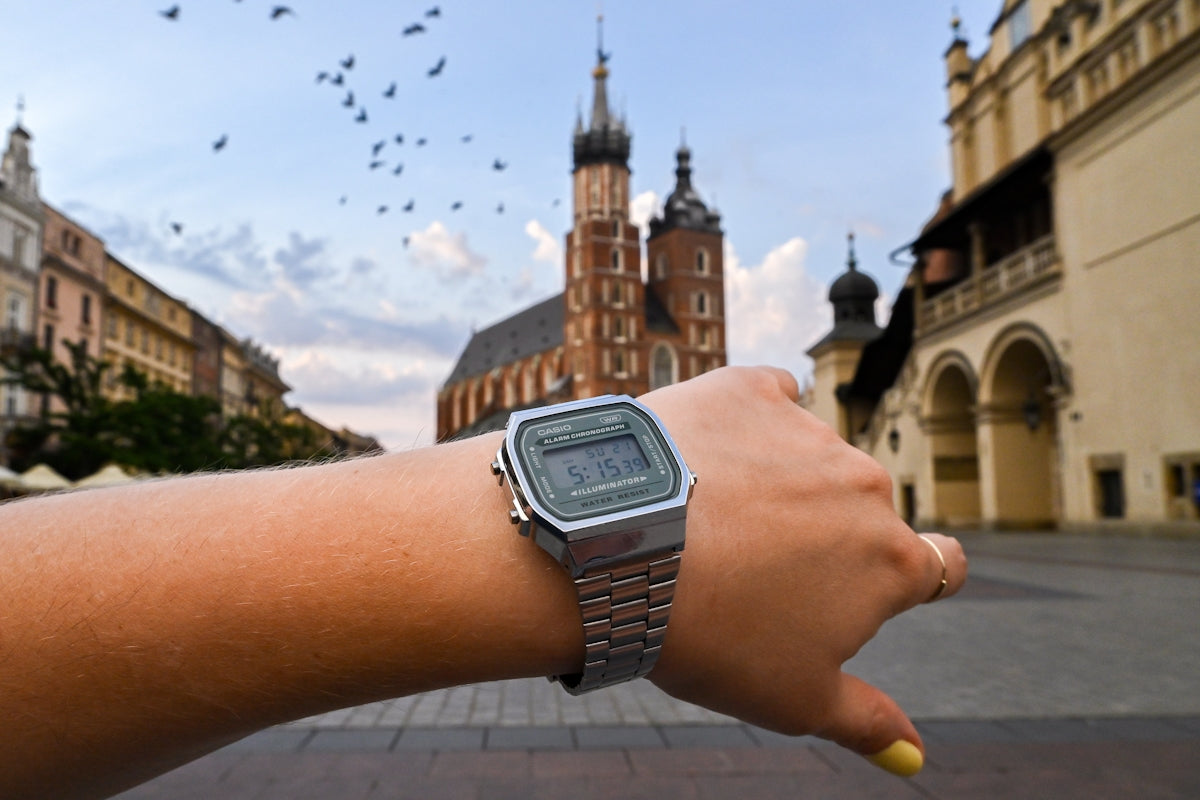
LCD display (digital quartz): Digital quartz watches bypass stepper motor entirely—the IC directly drives liquid crystal display showing time numerically. Digital quartz eliminates mechanical components (no gears, no hands), reducing power consumption and enabling additional functions (chronograph, alarm, world time, backlight) impossible or expensive in analog implementations.
Battery power: Small battery (silver oxide cell typically, lithium in some high-end or solar-rechargeable models) provides electric current powering entire system. Standard watch batteries deliver 1.5V, sufficient for quartz oscillator, IC, and stepper motor operation. Battery capacity determines service life—typical analog quartz watches consume 1-3 microamps, providing 2-5 year battery life from standard cells; digital watches consume more (LCD display and additional functions draw power), typically achieving 1-3 year battery life.

The Quartz Revolution: Historical Context
Quartz technology's introduction transformed watchmaking industry, creating upheaval so dramatic it earned designation "Quartz Crisis"—understanding this history contextualizes quartz watches' current market position.
Pre-Quartz Era: Mechanical Dominance
Before 1969, all watches used mechanical movements—mainspring providing power, escapement regulating energy release, balance wheel oscillating to control timekeeping. Swiss manufacturers dominated luxury market; American and Soviet manufacturers served mid-range and budget segments. Accuracy remained limited—even quality mechanical watches drifted ±10-30 seconds daily, requiring regular adjustment. Watch prices reflected mechanical complexity—entry-level mechanical watches cost $50-200 (1960s dollars), quality pieces $300-1000+, luxury watches $2000+.
Seiko Quartz Astron: The Game-Changer (1969)
On December 25, 1969, Seiko released the Astron—world's first commercially available quartz wristwatch. The Astron represented decade of development solving miniaturization challenges (fitting quartz oscillator, IC, battery, and stepper motor into wristwatch-sized package) and manufacturing cost reduction:
Revolutionary accuracy: The Astron achieved ±5 seconds monthly accuracy—60 times more accurate than typical mechanical watches. This performance eliminated daily time setting ritual mechanical watch owners accepted as inevitable.
Prohibitive initial pricing: The first Astron cost ¥450,000 (approximately $1,250 USD—equivalent to $10,000+ in 2025 dollars), matching price of Toyota Corolla automobile. Only 100 pieces produced first year due to complex hand-assembly requirements. The Astron served as technology demonstrator rather than mass-market product—Seiko knew quartz would transform watchmaking but needed to establish commercial viability before competitors copied technology.
The Quartz Crisis (1970s-1980s)
Within decade of Astron's introduction, quartz technology decimated traditional mechanical watchmaking:
Rapid cost decline: Manufacturing improvements and economies of scale reduced quartz watch costs dramatically. By mid-1970s, quartz watches cost $200-500; by early 1980s, reliable quartz watches sold for $20-100. This 10-50× cost reduction versus mechanical watches made quartz overwhelming value proposition for practical buyers.
Swiss industry collapse: Swiss mechanical watch manufacturers, dismissing quartz as inferior "electronic gimmick," continued producing mechanical watches as quartz competitors captured market share. Swiss watch employment plummeted from 90,000 workers (1970) to 28,000 (1985)—70% workforce reduction. Hundreds of Swiss watch brands disappeared; survivors faced bankruptcy.
Japanese and American ascendance: Seiko, Citizen, Casio (Japan) and Timex (USA) dominated quartz market through aggressive pricing and technological innovation. Casio introduced calculator watches, digital chronographs, and eventually G-Shock line (1983) exploiting quartz's durability advantages. These brands established quartz as practical choice for everyday wear—accurate, reliable, affordable, low-maintenance.
Mechanical Watch Renaissance (1990s-Present)
The quartz crisis didn't eliminate mechanical watches—instead, it forced redefinition:
Luxury repositioning: Swiss industry pivoted from "watches as timekeeping tools" to "watches as luxury goods and mechanical art." Brands emphasized craftsmanship, heritage, complications (perpetual calendars, tourbillons, minute repeaters)—attributes quartz couldn't replicate. This strategy succeeded—luxury mechanical watch market grew substantially 1990s-2020s despite quartz technical superiority.
Market segmentation: The watch market bifurcated into practical segment (quartz dominates—90%+ of units sold) and luxury/enthusiast segment (mechanical watches thrive despite higher costs and inferior accuracy). Most people own quartz watches for daily wear; mechanical watch enthusiasts appreciate mechanical complexity as horological art rather than practical tools.
Quartz vs Mechanical: Complete Comparison
Understanding fundamental differences between quartz and mechanical movements clarifies which technology suits specific needs and priorities.
Comprehensive Comparison Table
| Aspect | Quartz Movement | Mechanical Movement |
|---|---|---|
| Accuracy | ±10-20 sec/month (±0.3-0.7 sec/day average) | ±20-30 sec/day (±600-900 sec/month) |
| Power Source | Battery (2-5 years lifespan) | Mainspring (manual wind or automatic) |
| Maintenance | Battery replacement only ($10-20 every 2-5 years) | Service every 5-7 years ($150-800) |
| Daily Operation | No winding needed | Daily wearing (automatic) or winding (manual) |
| Typical Cost | $20-500 (luxury quartz $1000-5000+) | $300-5000+ (luxury $10,000+) |
| Seconds Hand Motion | Tick (one-second jumps) | Sweep (continuous motion, 6-10 beats/sec) |
| Thickness | Thinner (movement 2-4mm typical) | Thicker (movement 4-7mm typical) |
| Durability | Excellent (fewer components, better shock resistance) | Good (more delicate, balance assembly vulnerable) |
| Temperature Sensitivity | Minimal variation (-10°C to +60°C stable) | Accuracy affected by temperature extremes |
| Positional Variance | None (same accuracy all positions) | Significant (rate changes by position) |
| Craftsmanship Appeal | Minimal (electronic components, no visible complexity) | High (visible gears, finishing, complications) |
| Collectibility | Low (few exceptions like early Astron) | High (vintage appreciation, brand prestige) |
| Lifespan | 10-30 years (IC eventually fails, often unrepairable) | 50-100+ years (serviceable indefinitely with parts) |
When Quartz Makes Sense
Practical daily wear: If watch serves primarily as timekeeping tool rather than jewelry or status symbol, quartz delivers superior functionality—accuracy requiring monthly adjustment versus daily/weekly for mechanical, zero daily maintenance, reliable operation without winding concerns.
Budget constraints: Quartz enables reliable automatic timekeeping at $50-200 price points impossible with mechanical watches. Quality quartz watches from Citizen, Seiko, Casio, Timex cost less than single mechanical watch service.
Demanding environments: Quartz watches tolerate shock, vibration, and temperature extremes better than mechanical watches. Construction workers, athletes, military personnel, outdoor enthusiasts benefit from quartz durability and reliability.
Multiple watch rotation: Quartz watches don't stop when unworn—no need for watch winders or daily winding. Owners rotating between several watches benefit from grab-and-go convenience (all watches running, all accurate).
Precision requirements: Professions requiring accurate timekeeping (healthcare, aviation, navigation, scientific applications) favor quartz accuracy. While smartphones provide time reference, dedicated timepiece remains valuable in situations prohibiting phone access.
When Mechanical Makes Sense
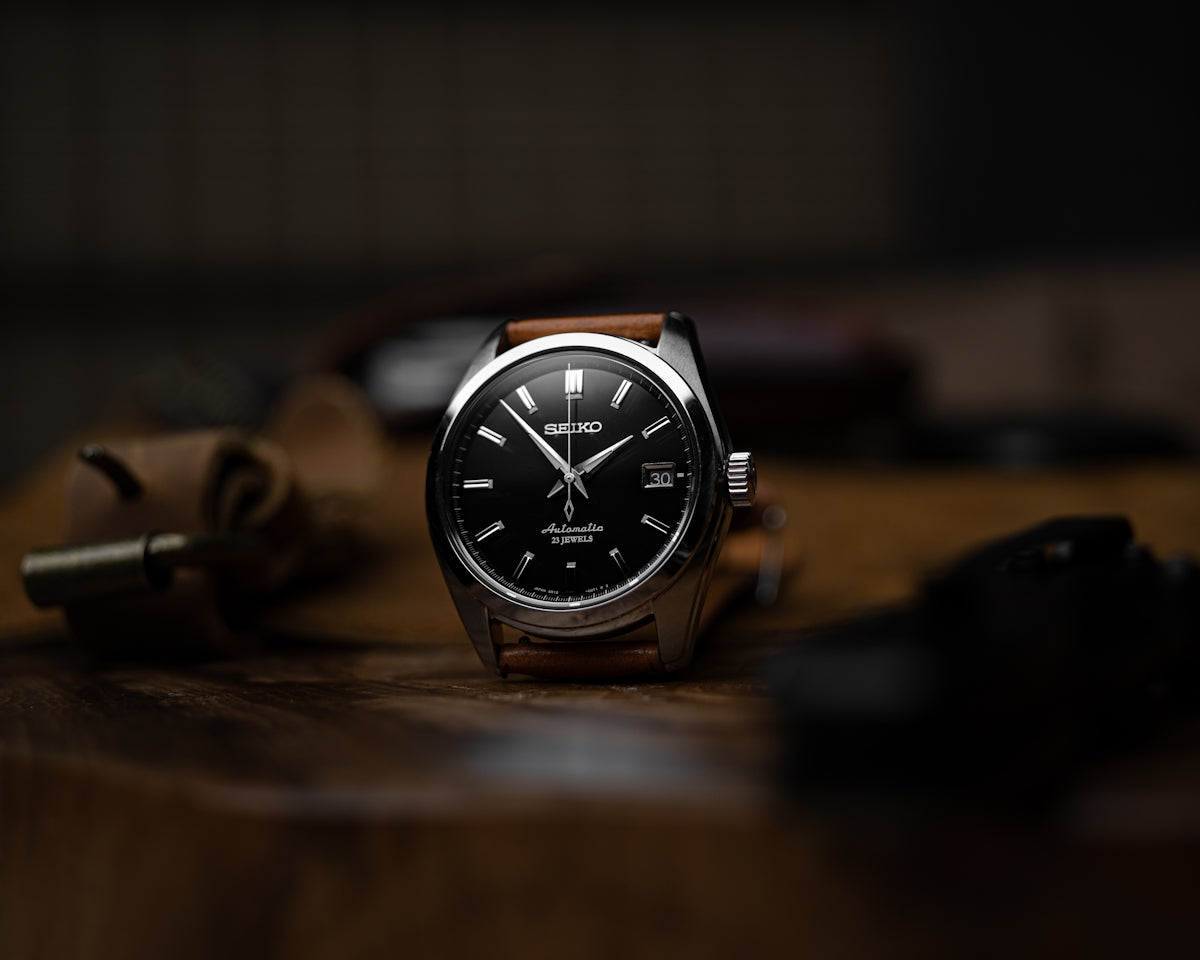
Horological appreciation: Enthusiasts valuing mechanical complexity, traditional craftsmanship, and watchmaking heritage prefer mechanical watches despite practical compromises. The visible gear train, escapement operation, and hand-finishing satisfy mechanical appreciation quartz can't provide.
No battery dependency: Mechanical watches operate indefinitely without battery replacement—daily wearing (automatic) or winding (manual) maintains operation across decades. This appeals to buyers uncomfortable with electronic dependency or preparing for battery supply disruptions.
Luxury and prestige: Luxury watch market centers on mechanical movements—Rolex, Patek Philippe, Audemars Piguet, Omega exclusively use mechanical calibers. The prestige, brand heritage, and status signaling require mechanical movements; luxury quartz exists but occupies tiny market segment.
Collectibility and investment: Mechanical watches from recognized brands hold value better than quartz alternatives. Vintage Rolex, Omega, Patek Philippe appreciate over decades; quartz watches experience typical electronics depreciation (near-zero resale value after 10-20 years except historically significant pieces).
Heirloom potential: Mechanical watches become family heirlooms spanning generations—50-100+ year service life with regular maintenance. Quartz watches eventually become unrepairable when IC fails (typically 20-40 years), limiting heirloom potential.
Types of Quartz Movements
Not all quartz movements are equal—understanding variations clarifies capability differences and pricing ranges.
Standard Quartz Movements
Specification: Basic quartz movements using standard 32,768 Hz crystal, simple IC, stepper motor advancing seconds hand once per second. Accuracy typically ±15-30 seconds monthly.
Applications: Budget watches ($20-200), fashion watches, promotional watches, most mainstream quartz watches. Examples: basic Timex, Casio, Citizen, Seiko quartz models.
Battery life: 2-3 years typical for analog models, 1-2 years for digital models with additional functions.
Cost: Bare movements cost $3-10 in volume, enabling extremely affordable complete watches.
High-Accuracy Quartz (HAQ) Movements
Specification: Enhanced quartz movements using temperature-compensated oscillator circuits, superior quality crystals, and precision ICs. Temperature compensation adjusts oscillator frequency based on thermistor readings, counteracting quartz crystal's thermal drift. Accuracy achieves ±5-10 seconds yearly (yes, yearly—not monthly).
Applications: Premium quartz watches from Grand Seiko (9F series), Citizen (Chronomaster, The Citizen), Longines (VHP - Very High Precision), Breitling (SuperQuartz). Prices range $1000-5000+.
Technical enhancements: Beyond temperature compensation, HAQ movements often include perpetual calendar (automatic leap year adjustment), instant-date-change mechanism (date flips instantaneously at midnight rather than gradually), and backlash auto-adjust (compensates for gear train slack maintaining hand alignment precision).
Why premium pricing? HAQ movements require hand-assembly, individual testing and adjustment, quality control exceeding standard quartz. Grand Seiko 9F movements undergo aging process (pre-running movement weeks before casing) and multi-position accuracy verification. This labor-intensive approach costs more than standard quartz but less than mechanical movements of comparable quality.
Solar-Powered Quartz
Technology: Solar quartz watches use photovoltaic cells beneath dial converting light (natural sunlight or artificial indoor lighting) into electrical energy charging rechargeable battery. The rechargeable battery (lithium-ion or similar) replaces standard disposable battery, eliminating battery replacement requirement.
Charging requirements: Typical solar quartz requires 10-20 hours direct sunlight (or 40-80 hours indirect indoor light) for full charge. Fully charged watch runs 6-24 months in darkness before depleting, enabling normal wearing patterns without dedicated charging sessions.
Applications: Citizen Eco-Drive (pioneering solar quartz brand), Seiko Solar, Casio Tough Solar. Prices range $150-1000+ depending on additional features and build quality.
Long-term economics: Solar quartz eliminates battery replacement costs over watch lifespan. However, rechargeable battery eventually loses charging capacity (typically 10-20 years), requiring specialized battery replacement costing $30-80 versus $10-20 for standard battery. Still, eliminating 5-10 battery replacements over 20 years provides net savings and convenience.
Kinetic/Auto-Quartz Hybrid
Technology: Seiko Kinetic and Citizen Eco-Drive (certain models) use automatic rotor system generating electricity through wrist motion. Rotor spins micro-generator producing electrical current charging rechargeable battery. The battery powers quartz oscillator and stepper motor—combining automatic watch convenience (no battery replacement) with quartz accuracy.
Power reserve: Kinetic watches typically achieve 1-6 months power reserve from full charge, depending on model and capacitor/battery capacity. This exceeds mechanical automatic watches' 40-72 hour reserves while maintaining quartz accuracy.
Market position: Seiko Kinetic dominated 1990s-2000s but faces reduced prominence in 2020s—solar quartz offers similar battery-replacement elimination with simpler technology. However, Kinetic appeals to mechanical watch enthusiasts wanting automatic watch experience with quartz accuracy benefits.
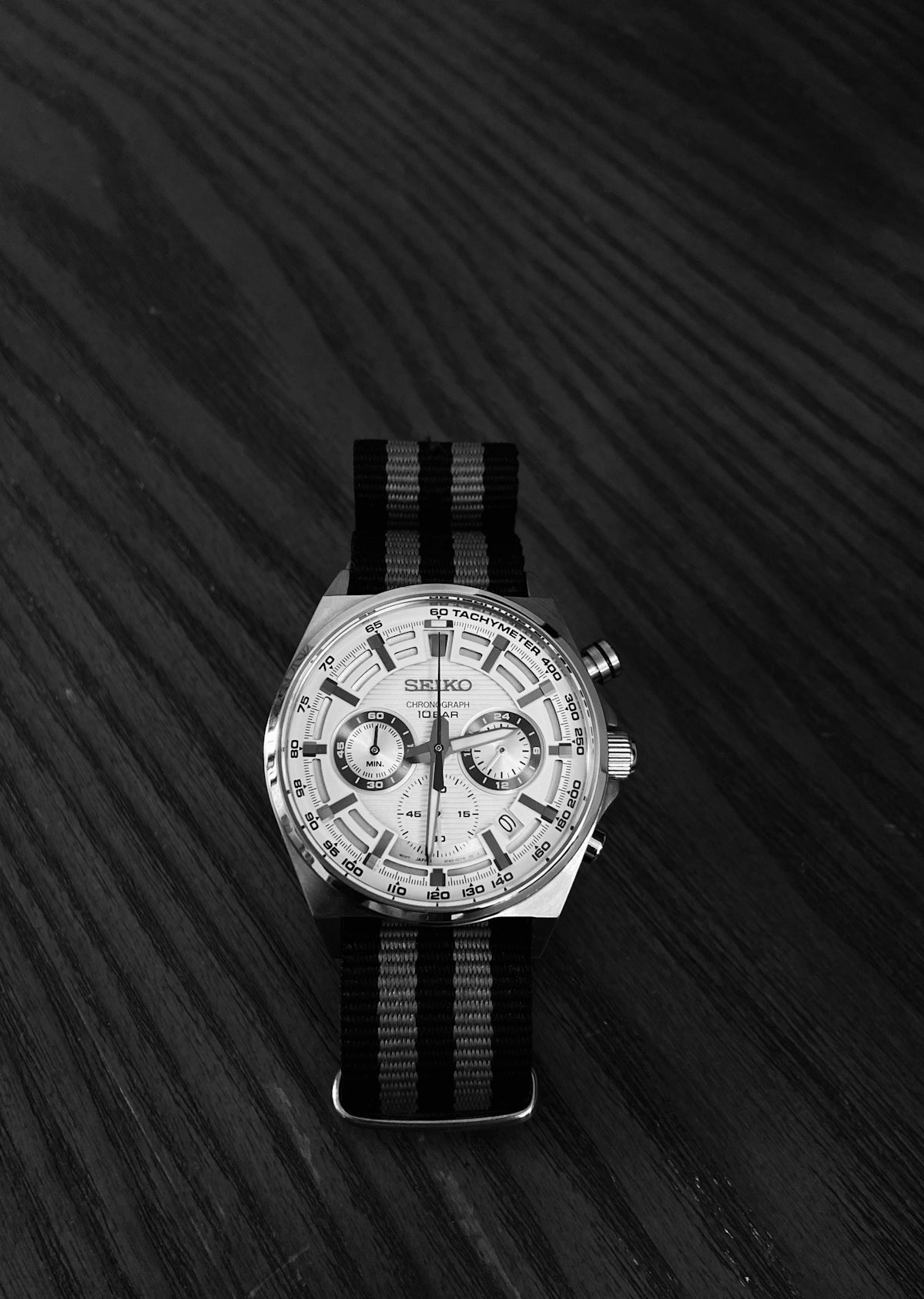
Meca-Quartz Chronograph
Hybrid architecture: Meca-quartz movements combine quartz timekeeping (hour, minute, seconds) with mechanical chronograph module. Base timekeeping uses quartz oscillator providing ±15-30 seconds monthly accuracy; chronograph complication operates purely mechanically—springs, gears, levers creating mechanical pusher feel and instant-reset function.
Why hybrid? Fully mechanical chronographs cost $500-5000+ due to complex movement construction. Fully quartz chronographs cost $20-200 but suffer from mushy pushers and stuttering chronograph hands. Meca-quartz delivers mechanical chronograph experience (crisp pushers, smooth sweep at 4 beats/second, instant reset) with quartz accuracy and affordable pricing ($100-400 complete watches).
Applications: Seiko VK-series movements (VK63, VK64, VK67) dominate affordable chronograph market. SKYRIM uses VK63/VK64 meca-quartz in chronograph offerings, combining genuine Seiko hybrid movements with customizable designs enabling personalized chronograph creation at $285-345. These watches deliver 90% of mechanical chronograph experience—tactile pushers, sweeping seconds, instant reset—at 10-20% of mechanical chronograph cost.
Quartz Watch Maintenance and Longevity
Understanding quartz maintenance requirements and realistic lifespan expectations enables informed ownership decisions.
Routine Maintenance
Battery replacement: Standard quartz watches require battery replacement every 2-5 years depending on movement power consumption and battery capacity. Cost ranges $10-20 at watch shops or jewelers including installation. DIY battery replacement possible with appropriate tools (caseback opener, tweezers) but risks dust contamination if not performed in clean environment. Signs requiring battery replacement: watch stopped, seconds hand jumping multiple seconds per tick (low battery warning in some movements), digital display dimming.
Gasket inspection: During battery replacement, watchmaker should inspect water-resistance gaskets (crystal gasket, caseback gasket, crown gasket). Gaskets deteriorate over time even without water exposure—5-10 year replacement recommended for watches regularly exposed to moisture. Gasket replacement costs $20-40 additional to battery replacement.
No other routine maintenance: Quartz movements don't require regular servicing like mechanical watches. The electronic components and minimal gear train (only reducing gears from stepper motor to hands) operate decades without lubrication or cleaning. This maintenance simplicity represents key quartz advantage—battery replacement every 2-5 years versus complete mechanical watch service every 5-7 years at 10-15× cost.
Longevity Expectations
Integrated circuit lifespan: The IC represents primary longevity limitation. Quality ICs operate 20-40+ years before failure; budget ICs may fail after 10-20 years. IC failure typically manifests as watch stopping, erratic timekeeping, or seconds hand behaving abnormally. IC failure usually renders watch unrepairable—replacement ICs for specific movements often unavailable, and even when available, replacement cost approaches new watch cost for budget models.
Quartz crystal longevity: Quartz crystals themselves last indefinitely under normal conditions—the crystal won't wear out or fail absent physical damage. Crystal frequency drift over decades remains minimal (few parts per million), maintaining accuracy throughout watch lifespan.
Stepper motor and gear train: Mechanical components (stepper motor, gear train, hands) outlast ICs—30-50+ years typical lifespan. These components experience minimal wear due to low force requirements and infrequent movement (seconds hand advances once per second, minute hand every 60 seconds, hour hand every 60 minutes).
Realistic total lifespan: Quality quartz watches achieve 20-40 year service life before IC failure. Budget quartz watches may fail after 10-20 years. When failure occurs, replacement usually makes more economic sense than repair—$50-200 for new quality quartz watch versus $100-150+ for movement replacement in old watch. This contrasts mechanical watches' indefinite serviceability—properly maintained mechanical watches operate 50-100+ years with periodic service.
Extending Quartz Watch Life
Store in moderate temperatures: Extreme temperatures stress ICs and accelerate aging. Avoid leaving watch in vehicles during summer (interior temperatures reach 140°F+), storing in freezers or refrigerators, or exposing to prolonged heat sources.
Replace battery promptly: When battery dies, replace within weeks. Dead battery left in watch risks leakage—battery chemicals corrode movement components causing irreparable damage. Set calendar reminder for battery replacement interval (note battery replacement date, set reminder for 2-3 years future).
Respect water resistance ratings: Quartz movements themselves aren't water resistant—case sealing provides protection. Respect watch water resistance ratings (don't swim with 30m watch, don't dive with 100m watch) and avoid hot water exposure (showers, hot tubs) which stress gaskets and case seals.
Common Quartz Watch Misconceptions
Several myths about quartz watches persist—correcting these clarifies realistic expectations.
Misconception: Quartz Watches Are Always Cheap
Reality: While most quartz watches cost $20-500, premium quartz exists at $1000-10,000+. Grand Seiko 9F series ($2000-5000+), Breitling SuperQuartz ($3000-6000+), haute horlogerie quartz pieces from Patek Philippe or Piaget (when produced) commanded luxury pricing. These watches deliver ±5-10 seconds yearly accuracy, perpetual calendars, instant-date-change mechanisms, and finishing quality matching mechanical luxury watches. The pricing reflects hand-assembly, quality control, and brand prestige rather than movement material costs.
Misconception: Quartz Is Less Durable Than Mechanical
Reality: Quartz movements tolerate shock, vibration, and temperature extremes better than mechanical balance assemblies. Mechanical watches risk balance staff damage, hairspring damage, or jewel displacement from significant impacts. Quartz movements, lacking delicate balance assembly, resist shock better. G-Shock watches exploit this—quartz movements survive drops, impacts, and abuse destroying mechanical watches. However, quartz watches face different vulnerability: electronic component failure (IC aging, crystal damage) versus mechanical wear. Different failure modes, not objectively more or less durable—depends on specific risks.
Misconception: All Quartz Watches Tick
Reality: Most quartz watches tick (seconds hand advancing in one-second jumps), but smooth-sweep quartz exists. High-frequency quartz movements advance seconds hand multiple times per second (typically 4-8 times), creating smoother sweep approaching mechanical watch motion. Grand Seiko Spring Drive (technically not pure quartz—hybrid mechanical-quartz) achieves perfectly smooth sweep. Smooth-sweep quartz addresses primary aesthetic criticism (ticking motion) while retaining quartz accuracy advantages.
Misconception: Quartz Killed Mechanical Watchmaking
Reality: Quartz nearly killed mechanical watchmaking 1970s-1980s but ultimately forced evolution rather than extinction. Mechanical watches survive by emphasizing attributes quartz can't replicate—craftsmanship, heritage, complications, prestige. The modern watch market accommodates both technologies serving different purposes: quartz for practical timekeeping, mechanical for horological appreciation and luxury goods. Mechanical watch production and luxury market sales both increased substantially 2000-2020 despite quartz technical dominance—proving market space exists for both.
Choosing Your First Quartz Watch
Practical guidance for buyers selecting quartz watches for specific applications and budgets.
Daily Wear Watch ($50-200)
Priorities: Reliability, accuracy, low maintenance, appropriate water resistance for daily activities, comfortable wearing experience.
Recommended features: Date display (practical reference), 50-100m water resistance (enables swimming, showering without removal), sapphire crystal if budget allows (scratch resistance), bracelet or quality strap.
Example watches: Citizen Corso ($100-150, solar-powered, date, 100m WR), Seiko SNE498 ($120-160, solar, date, 100m WR), Timex Waterbury ($80-120, standard quartz, date, 50m WR).
Dress Watch ($100-300)
Priorities: Thin profile (fits under dress shirt cuff), clean dial aesthetics, quality finishing, appropriate formality level.
Recommended features: Slim case (under 10mm total thickness if possible), simple dial (no chronograph subdials or excessive complications), leather strap, polished or mixed finishing, conservative diameter (36-40mm).
Example watches: Orient Bambino Quartz ($150-200, thin profile, dress aesthetics), Citizen Stiletto ($180-250, ultra-thin solar quartz), Seiko Presage Quartz models ($250-400, premium finishing).
Sports/Tool Watch ($150-400)
Priorities: Durability, water resistance for intended activities, legibility, features matching sport requirements (timing, multiple time zones, tide information, etc.).
Recommended features: 100-200m+ water resistance for water sports, screw-down crown, robust case construction, highly legible dial, appropriate complications (chronograph for timing, rotating bezel for dive timing or second time zone, etc.).
Example watches: Citizen Promaster Dive ($250-400, 200m WR, ISO-rated dive watch), Casio G-Shock GA-2100 ($100-150, extreme durability, 200m WR), SKYRIM chronograph models ($285-345, VK63/VK64 meca-quartz, customizable sports watch designs combining quartz reliability with personal aesthetic preferences).
Premium Quartz ($500-2000+)
Priorities: Superior accuracy (HAQ movements), exceptional finishing, perpetual calendar convenience, luxury brand prestige, or specific advanced features.
Recommended features: Temperature-compensated movement (±5-10 seconds yearly accuracy), sapphire crystal, premium case materials (titanium, high-grade stainless, gold), advanced complications (perpetual calendar, GMT, etc.), exhibition caseback showing decorated movement.
Example watches: Grand Seiko SBGX series ($2000-3000, 9F quartz, ±10 sec/year, exceptional finishing), Longines Conquest VHP ($1200-2000, ±5 sec/year, perpetual calendar, GPD—gear position detection system), Breitling Colt Quartz ($2000-3000, SuperQuartz ±10 sec/year, COSC-certified).
Frequently Asked Questions
How accurate are quartz watches?
Standard quartz watches achieve ±15-30 seconds monthly accuracy (±0.5-1 second daily average)—approximately 60 times more accurate than typical mechanical watches (±20-30 seconds daily). High-accuracy quartz (HAQ) movements achieve ±5-10 seconds yearly through temperature compensation—roughly 1000 times more accurate than mechanical watches. This accuracy eliminates frequent time setting—standard quartz requires adjustment monthly or less, HAQ requires adjustment annually or less.
How long do quartz watch batteries last?
Typical battery life ranges 2-5 years depending on movement power consumption and battery capacity. Analog quartz watches (simple three-hand models) achieve 3-5 years; chronograph or multi-function analog watches achieve 2-3 years; digital watches with backlight and multiple functions achieve 1-3 years. Solar-powered quartz eliminates battery replacement—rechargeable battery lasts 10-20 years before capacity degradation requires replacement.
Are quartz watches worth collecting?
Generally no—quartz watches lack collectibility and appreciation potential of mechanical watches, with rare exceptions. Early Seiko Astron, significant historical pieces, and certain luxury quartz (Patek Philippe Beta 21, early Omega Seamaster Quartz) hold collector interest. However, 99%+ of quartz watches experience typical electronics depreciation—minimal resale value after 5-10 years. Buy quartz watches for wearing, not investment or collecting.
Can quartz watches be repaired?
Yes for mechanical failures (crystal damage, crown damage, water ingress, battery replacement). No for IC failure—when integrated circuit fails (typically 20-40 years), repair usually impossible or uneconomical. Replacement ICs for specific movements often unavailable, and replacement cost approaches new watch cost for budget models. Premium quartz watches (Grand Seiko 9F, etc.) may remain serviceable longer due to manufacturer parts support, but even these eventually become unrepairable when parts discontinue.
Do quartz watches need servicing like mechanical watches?
No—quartz watches require only battery replacement every 2-5 years ($10-20). Unlike mechanical watches requiring complete overhaul every 5-7 years ($150-800), quartz movements operate decades without servicing. During battery replacement, watchmaker may inspect gaskets and recommend replacement if deteriorated ($20-40), but this remains optional unless water resistance critical. This minimal maintenance represents key quartz advantage—lifetime ownership costs dramatically lower than mechanical watches.
Why do expensive quartz watches cost so much?
Premium quartz pricing reflects hand-assembly, advanced technology (temperature-compensated circuits, perpetual calendar mechanisms), exceptional finishing, premium materials, and brand prestige rather than raw movement costs. Grand Seiko 9F movements undergo extensive hand-finishing—polished bevels, grained plates, blued screws—matching mechanical watch finishing. These movements require hand-assembly and individual testing mechanical watches don't need. However, even premium quartz costs less to manufacture than comparable mechanical movements—the pricing includes substantial luxury brand markup.
Conclusion: Quartz in Perspective
Quartz technology transformed watchmaking by solving mechanical watches' accuracy limitations. The 60× accuracy improvement (±15 seconds monthly versus ±20-30 seconds daily), minimal maintenance (battery every 2-5 years versus service every 5-7 years), and affordable pricing ($50-300 versus $500-5000+ mechanical) makes quartz the overwhelming practical choice for watch-as-tool applications.
Yet quartz didn't eliminate mechanical watches—it forced evolution. Mechanical watches survive by emphasizing attributes quartz can't replicate: visible craftsmanship, traditional heritage, perpetual operation without batteries, collectibility and heirloom potential. The modern watch market accommodates both technologies serving different priorities: quartz for accuracy and pragmatic value; mechanical for horological appreciation and emotional connection.
For practical daily wear, quartz delivers superior functionality at accessible pricing. Whether $50 Casio, $150 Citizen Eco-Drive, or $2000 Grand Seiko 9F, quartz provides reliable timekeeping requiring monthly adjustment at most, zero daily interaction, and minimal lifetime costs.
The choice between quartz and mechanical depends on whether watch serves primarily as tool or art. If timekeeping tool, quartz excels—superior accuracy, reliability, and value justify overwhelming market dominance (90%+ of watches sold). If horological art or luxury good, mechanical watches offer emotional satisfaction and prestige quartz can't match. Neither choice is wrong—they serve different purposes for different buyers. Understanding both technologies enables informed decisions matching watch choice to intended purpose.
Share:
Tags:
Luxury Watches Under $300: Top Affordable Premium Timepieces Guide
What is a Field Watch? Definition & Complete Guide 2025