


A chronograph watch is a timepiece with a built-in stopwatch function, operated through pushers on the side of the case that start, stop, and reset a timing mechanism independently from the regular time display. The word "chronograph" comes from Greek: "chronos" (time) and "graph" (writing)—literally meaning "time writer." This complication allows you to measure elapsed time for activities like cooking, sports, or parking while the watch continues showing regular time on its main hands.
This complete guide explains everything beginners need to know about chronograph watches: how the timing mechanism works, the difference between a chronograph and a stopwatch, what distinguishes chronographs from regular watches, the types of movements available, advantages and disadvantages of ownership, price ranges from entry-level to luxury, and guidance on whether a chronograph suits your needs and lifestyle.

How Does a Chronograph Work?
The Basic Mechanism
A chronograph operates through a separate gear train dedicated to timing functions, completely independent from the timekeeping mechanism. When you press the start pusher, a clutch engages the chronograph gear train, causing the chronograph seconds hand to begin sweeping. The regular hour and minute hands continue their normal timekeeping unaffected.
This independence is crucial: you can start, stop, and reset the chronograph repeatedly without affecting the accuracy of your watch's time display. The two systems share the same power source (mainspring in mechanical, battery in quartz) but operate through separate mechanical pathways.

The Three Controls
Crown (center position): Adjusts regular time and date—identical to non-chronograph watches. The crown does NOT control chronograph functions.
Top Pusher (2 o'clock): Start and Stop button. Press once to start timing, press again to stop. The chronograph hands freeze in position showing elapsed time.
Bottom Pusher (4 o'clock): Reset button. Press to return all chronograph hands to zero. On most chronographs, only press when the chronograph is stopped.
Understanding the Display
Chronograph watches feature multiple displays that confuse beginners:
Large Central Seconds Hand: On most chronographs, this is the chronograph seconds hand—it only moves when you start the chronograph, not continuously. This is your primary timing display.
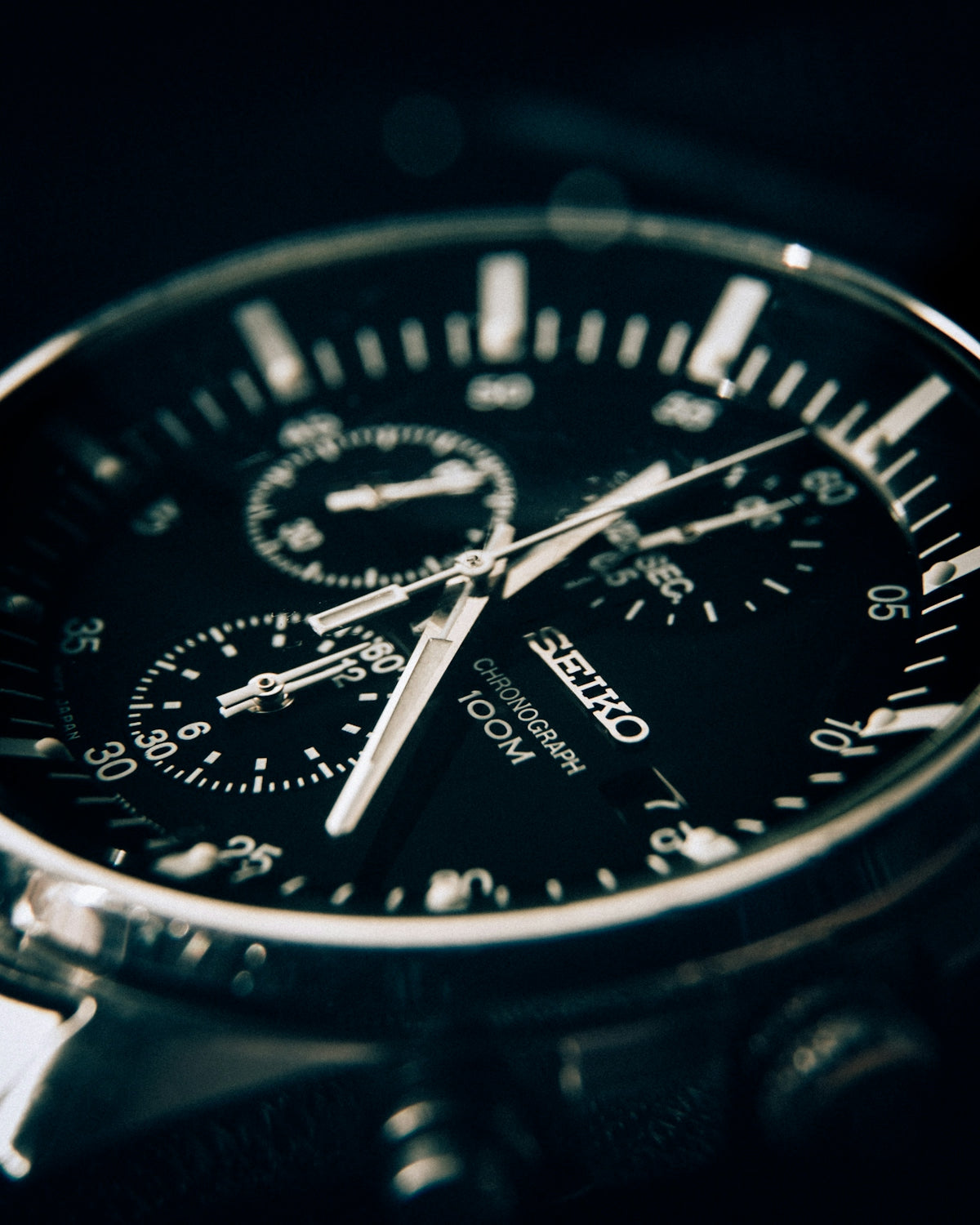
Subdials (small circles on the dial):
- Running Seconds: A small subdial (usually at 9 o'clock) showing continuous seconds for regular timekeeping
- Minute Counter: Counts elapsed minutes when chronograph runs (usually at 3 o'clock)
- Hour Counter: Counts elapsed hours for long timing sessions (usually at 6 o'clock)
The key confusion: the large central seconds hand shows chronograph elapsed time, NOT regular seconds. Look for the small continuously-moving subdial for current seconds.

Chronograph vs Stopwatch: What's the Difference?
Fundamental Distinction
A chronograph is a watch complication—a feature built into a complete timepiece that also tells regular time. A stopwatch is a dedicated single-purpose timing device with no timekeeping function.
| Aspect | Chronograph | Stopwatch |
|---|---|---|
| Primary Function | Timekeeping + elapsed time measurement | Elapsed time measurement only |
| Form Factor | Wristwatch worn daily | Handheld device |
| Regular Time Display | Yes (hour, minute, seconds) | No |
| Typical Use | Daily wear with occasional timing | Dedicated timing activities (sports, lab) |
| Accuracy | Typically 1/5 to 1 second resolution | Often 1/100 second or better |
| Price Range | $100-$50,000+ | $10-$500 |
When Each Makes Sense
Choose a Chronograph When: You want timing capability integrated into your everyday watch. Chronographs suit people who occasionally time cooking, parking, workouts, or casual activities while wearing a complete wristwatch.
Choose a Stopwatch When: You need maximum timing precision for professional applications—sports coaching, laboratory work, or competitive racing where 1/100-second accuracy matters and you'll dedicate full attention to timing rather than wearing it.

Chronograph vs Regular Watch
Visual Differences
You can identify a chronograph at a glance through several distinctive features:
Pushers: Chronographs have two buttons (pushers) flanking the crown at 2 o'clock and 4 o'clock positions. Regular watches have only the crown.
Subdials: Most chronographs display 2-3 small circular subdials on the main dial face. Regular watches typically have clean dials without subdials (except for some with date windows or moon phases).
Central Seconds Behavior: On chronographs, the large central seconds hand remains stationary until you start the chronograph function. On regular watches, it sweeps continuously showing current seconds.
Practical Differences
Case Thickness: Chronographs run thicker than comparable regular watches due to the additional mechanism. A typical automatic chronograph measures 13-16mm thick versus 10-12mm for regular automatics. This affects shirt cuff compatibility and overall wearing comfort.
Complexity: Chronograph movements contain more parts (up to 300+ components in mechanical versions) than simple timekeeping movements (around 130 parts). More parts mean potentially more maintenance requirements and higher service costs.
Dial Legibility: The subdials and additional hands on chronographs can reduce quick time-reading clarity compared to minimalist regular watch dials. Some people prefer the "busy" chronograph aesthetic; others find it distracting.
Important Clarification
A chronograph is a complication (additional function), not a watch type. You can have:
- Automatic chronographs (self-winding mechanical)
- Manual-wind chronographs (hand-wound mechanical)
- Quartz chronographs (battery-powered)
"Chronograph" describes what the watch does (timing), not how it's powered. This differs from "automatic" which describes how the watch operates (self-winding via rotor).

Chronograph vs Automatic Watch: What's the Real Difference?
One of the most common questions beginners ask: "Should I get a chronograph or an automatic watch?" This question reveals a fundamental misunderstanding—these terms describe completely different aspects of a watch and aren't mutually exclusive. For a complete explanation of automatic watches, see our guide on what is an automatic watch.
They Describe Different Things
Chronograph describes a watch's function—specifically, the built-in stopwatch capability with start/stop/reset pushers and timing subdials.
Automatic describes a watch's power source—specifically, a mechanical movement that winds itself through a weighted rotor spinning as you move your wrist.
These concepts are orthogonal, meaning they operate on different axes entirely. Asking "chronograph or automatic?" is like asking "sedan or gasoline?"—one describes what the vehicle does, the other describes how it's powered.
The Four Combinations You Can Actually Buy
| Combination | What It Means | Example Price Range |
|---|---|---|
| Automatic Chronograph | Self-winding mechanical watch WITH timing function | $500-$50,000+ |
| Manual-Wind Chronograph | Hand-wound mechanical watch WITH timing function | $300-$30,000+ |
| Quartz Chronograph | Battery-powered watch WITH timing function | $100-$1,000 |
| Automatic (Non-Chronograph) | Self-winding mechanical watch WITHOUT timing function | $200-$20,000+ |
Which Should You Choose?
Choose an Automatic Chronograph if: You want the prestige of mechanical watchmaking combined with practical timing capability. These watches appeal to enthusiasts who appreciate complex movements and use the stopwatch function. Expect thicker cases (14-16mm) and higher prices due to movement complexity.
Choose a Quartz Chronograph if: You want reliable timing function at an accessible price point. Meca-quartz options like the Seiko VK63 movement offer smooth sweeping chronograph hands with battery-powered reliability. SKYRIM WRIST Seiko Mod Daytona Panda exemplifies this category—chronograph functionality without the maintenance requirements of mechanical movements.
Choose an Automatic (Non-Chronograph) if: You love mechanical watches but don't need timing capability. Simple automatic watches run thinner (10-12mm), cost less than equivalent automatic chronographs, and offer cleaner dial aesthetics. Learn more in our automatic watch guide.
Bottom Line: If you need timing functions, choose a chronograph. Then decide between quartz (affordable, reliable) or automatic (prestigious, complex). If you don't need timing, skip the chronograph complication entirely.
Types of Chronograph Movements
Mechanical Chronographs
Mechanical chronographs use spring-powered movements with intricate gear systems. Two main types exist:
Column-Wheel Chronographs: Premium mechanical design using a cylindrical column wheel to engage the chronograph. Provides smooth pusher feel and precise operation. Found in high-end Swiss chronographs ($3,000+).
Cam-Actuated Chronographs: More affordable mechanical design using cam levers instead of column wheel. Slightly less refined pusher feel but equally reliable. Common in mid-range mechanical chronographs ($500-$3,000).
Mechanical Characteristics:
- Sweeping chronograph seconds hand (smooth motion)
- Requires regular service (every 5-7 years)
- Appreciated for craftsmanship and engineering complexity
- Higher price point ($500-$50,000+)
Quartz Chronographs
Quartz chronographs use battery-powered electronic circuits to control timing functions. Modern quartz chronograph movements like the Seiko VK63 (found in watches like the Mod Daytona Panda at $300) combine quartz accuracy with mechanical-style chronograph operation—the seconds hand sweeps smoothly rather than ticking in one-second increments.
Quartz Characteristics:
- Superior accuracy (typically ±15 seconds per month)
- Lower maintenance (battery replacement every 2-3 years)
- More affordable ($100-$1,000 typical range)
- Often includes reset prevention (won't damage if you press reset while running)
- Reliable for practical timing use
Which Movement Type to Choose?
For practical timing use and reliability, quartz chronographs offer better value. For watch enthusiasm and mechanical appreciation, quality mechanical chronographs provide horological depth. Both operate identically from a user perspective—start, stop, reset functions work the same way.
Advantages and Disadvantages of Chronograph Watches
Advantages
Practical Utility: Time cooking, workouts, parking meters, meetings, or any activity requiring elapsed time measurement without carrying a separate device.
Versatile Styling: Chronographs offer sporty, dynamic aesthetics suitable for casual and smart-casual contexts. The busy dial creates visual interest and presence on the wrist.
Conversation Pieces: The additional subdials and pushers invite questions and discussions. Mechanical chronographs especially appeal to those appreciating engineering complexity.
Resale Value: Quality chronographs (especially from established brands) often maintain or appreciate in value better than simple three-hand watches due to their complexity and desirability.
Disadvantages
Increased Thickness: Chronograph movements add 2-4mm case thickness compared to regular watches. This affects comfort under shirt cuffs and can feel bulky on smaller wrists.
Higher Maintenance Costs: Mechanical chronographs require specialized service (more expensive than standard watch service) due to additional components. Service intervals may be more frequent with heavy chronograph use.
Reduced Dial Legibility: The subdials and extra hands can make quick time-checking slightly slower than clean-dial watches. This matters if you frequently glance at your watch in professional meetings.
Higher Purchase Price: Chronograph complications add $50-$500+ to comparable non-chronograph watches. You pay for the additional mechanism whether you use it frequently or rarely.
Mechanical Vulnerability: On mechanical chronographs, pressing reset while running can damage the mechanism. Users must learn proper operation (stop before reset) to avoid costly repairs.
How Much Does a Chronograph Watch Cost?
Entry-Level: $100-$300
Quartz chronographs from brands like Casio Edifice, Timex Waterbury, Citizen Eco-Drive, and Seiko SSB. These offer reliable timing functions with battery-powered accuracy. Excellent for first-time chronograph buyers testing whether they'll use the function.
Example: The SKYRIM WRIST Seiko Mod Daytona Panda at $300 represents the upper end of this range, featuring the Seiko VK63 meca-quartz movement that provides smooth sweeping chronograph operation typically found in more expensive pieces, with a classic Daytona-inspired aesthetic.
Mid-Range: $300-$1,500
Entry-level mechanical chronographs and premium quartz options. Notable examples include Seiko Presage Chronograph, Orient Neo70s, Tissot PR516, and Hamilton Intra-Matic Chronograph. You get established brand names, better finishing, and more refined movements at this tier.
Premium: $1,500-$5,000
Quality Swiss mechanical chronographs with in-house or established calibers. Look at TAG Heuer Carrera, Longines Master Collection Chronograph, Oris Big Crown ProPilot, and Tudor Black Bay Chrono. Expect better movement finishing, sapphire crystals, and superior build quality.
Luxury: $5,000-$15,000
Prestigious chronographs from brands like Omega Speedmaster Professional, Breitling Navitimer, and Zenith Chronomaster. Features include column-wheel movements, elaborate finishing, rich brand heritage, and strong resale value.
Ultra-Luxury: $15,000+
Haute horlogerie chronographs from Rolex, Patek Philippe, Audemars Piguet, and A. Lange & Söhne. These represent pinnacle watchmaking with hand-finished movements, precious metals, and significant investment/collector value.
Who Should Buy a Chronograph Watch?
A Chronograph Is Right For You If:
- You actually time things: Cooking, workouts, parking, sports activities—if you regularly measure elapsed time, a chronograph provides practical value
- You appreciate mechanical complexity: The engineering behind chronograph movements fascinates you, and you enjoy owning complicated watches
- You prefer sporty aesthetics: The busy dial, multiple subdials, and pushers appeal to your sense of style
- You want a versatile daily watch: Chronographs work for casual, smart-casual, and some business contexts without appearing overly dressy
- You enjoy conversation starters: You like explaining watch functions and discussing horology with interested people
A Chronograph May Not Be Right For You If:
- You never time anything: If you can't remember the last time you needed to measure elapsed time, the chronograph function adds cost and complexity without benefit
- You prioritize slim profiles: Chronographs are inherently thicker—if sleeve clearance matters for your wardrobe, consider simpler watches
- You prefer minimalist design: If clean, uncluttered dials appeal to you, chronograph subdials may feel too busy
- You need maximum legibility: Quick time-checking is faster on simple three-hand watches than chronographs with multiple displays
- Budget is tight: The same budget buys a higher-quality simple watch than a chronograph—you're paying for the additional mechanism
Frequently Asked Questions
What does chronograph mean on a watch?
Chronograph means the watch includes a built-in stopwatch function operated through pushers on the case side—typically one at 2 o'clock (start/stop) and one at 4 o'clock (reset). The term comes from Greek "chronos" (time) and "graph" (writing), literally "time writer." A chronograph allows you to measure elapsed time for activities while the watch continues displaying regular time through its main hour and minute hands. The chronograph function operates independently from timekeeping—you can start, stop, and reset timing without affecting your watch's accuracy. Most chronographs display elapsed seconds on the large central hand and elapsed minutes/hours on smaller subdials.
Is a chronograph the same as a stopwatch?
No, a chronograph and stopwatch serve similar timing functions but differ fundamentally. A chronograph is a complication built into a complete wristwatch—it tells regular time AND measures elapsed time. A stopwatch is a standalone device dedicated solely to timing with no regular timekeeping function. You wear a chronograph daily as your watch, using the timing function occasionally. You carry a stopwatch specifically when you need to time something (sports coaching, laboratory work). Chronographs typically offer 1/5 to 1-second timing resolution; dedicated stopwatches often achieve 1/100-second precision. Both measure elapsed time, but chronographs integrate this into a complete timepiece.
Why are chronograph watches so expensive?
Chronograph watches cost more than comparable non-chronograph watches because the timing mechanism requires additional components—up to 200 extra parts in mechanical versions. Manufacturing these parts, assembling them precisely, and ensuring reliable operation adds production cost. Mechanical chronographs require specialized watchmaking skills to build and service. The additional complexity also increases development costs that manufacturers pass to buyers. However, quartz chronographs have dramatically reduced the entry price—you can buy reliable quartz chronographs for $100-$300. Expensive chronographs ($5,000+) command premiums for brand prestige, finishing quality, in-house movements, and collectibility rather than basic timing function.
Can a chronograph watch be used for diving?
Most chronograph watches should NOT have their pushers pressed underwater, even if the watch has water resistance ratings of 100m or 200m. Water resistance ratings typically apply to the sealed case with all pushers in resting position. Pressing pushers underwater breaks the seal at the pusher gaskets, allowing water entry that damages the movement. Only specialized dive chronographs explicitly rated for underwater pusher operation (very expensive professional models) can safely time activities underwater. For swimming and casual water exposure, leave chronograph pushers alone—use only the regular timekeeping function. If you need underwater timing, use a dive computer or dedicated underwater timing device.
How accurate is a chronograph watch?
Chronograph timing accuracy depends on movement type. Quartz chronographs achieve excellent precision—typically measuring to 1/5 second (0.2 seconds) or better, with timekeeping accuracy of ±15 seconds per month. Mechanical chronographs vary based on quality but generally measure to 1/4 or 1/5 second, with timekeeping accuracy of ±5-15 seconds per day. For everyday timing needs (cooking, parking, casual sports), both types provide more than sufficient precision. The practical limiting factor is human reaction time (0.2-0.3 seconds) when pressing the pushers, not the chronograph mechanism itself. Professional timing applications requiring 1/100-second accuracy use dedicated electronic timing equipment, not wristwatch chronographs.
Is a chronograph the same as an automatic watch?
No, chronograph and automatic describe completely different aspects of a watch. A chronograph is a function—specifically a built-in stopwatch with start/stop/reset pushers and timing subdials. Automatic describes the power source—a self-winding mechanical movement powered by a rotor that spins as you move your wrist. These terms aren't opposites or alternatives; they're independent features. You can buy an automatic chronograph (mechanical self-winding watch WITH stopwatch function), a quartz chronograph (battery-powered watch WITH stopwatch function), or a simple automatic watch (mechanical self-winding watch WITHOUT stopwatch function). When someone asks "chronograph or automatic?" they're usually confused about watch terminology—a watch can be both automatic AND a chronograph simultaneously.
Can a watch be both chronograph and automatic?
Yes, absolutely. An automatic chronograph combines self-winding mechanical movement with built-in stopwatch functionality. These watches feature both a rotor (visible through case backs) that winds the mainspring as you move AND pushers on the case side for timing functions. Automatic chronographs represent some of the most complex wristwatch movements available, containing 300+ components versus roughly 130 in simple automatic watches. Examples include the Omega Speedmaster with caliber 3861, TAG Heuer Carrera with Heuer 02, and Zenith El Primero. The complexity adds cost ($2,000-$50,000+) and thickness (14-16mm typical) compared to non-chronograph automatics, but appeals to enthusiasts who appreciate mechanical engineering and want timing capability.
Conclusion
A chronograph watch combines regular timekeeping with a built-in stopwatch function, operated through pushers that start, stop, and reset an independent timing mechanism. The chronograph complication adds practical utility (timing cooking, workouts, parking), sporty aesthetics (subdials, pushers, dynamic dial design), and mechanical interest (complex movement engineering)—balanced against increased thickness, higher maintenance costs, and busier dial legibility compared to simple watches.
Understanding what a chronograph offers helps determine whether it suits your needs. If you regularly time activities and appreciate the sporty aesthetic, a chronograph provides genuine value. If you rarely need elapsed time measurement and prefer slim, minimalist designs, simpler watches may serve you better. The choice reflects personal priorities rather than one option being objectively superior. Quality chronographs from entry-level quartz ($100-$300) through luxury mechanical ($5,000+) deliver reliable timing—your budget and preferences determine the right level.


Share:
Tags:
Panda Dial Watches: The Iconic Chronograph Style Explained
Are Miyota Movements Good? Quality and Reliability Guide