


Quick Answer: A chronograph watch is a timepiece with built-in stopwatch functionality. It displays regular time (hours, minutes, seconds) while also featuring additional subdials and pushers that measure elapsed time separately. This lets you time events—like a phone call, cooking, or a lap—without losing track of the current time. The word comes from Greek: "chronos" (time) + "graph" (writing).

Chronograph vs Standard Watch: Key Differences
The easiest way to understand a chronograph is to compare it with a standard watch:
| Feature | Standard Watch | Chronograph Watch |
|---|---|---|
| Controls | Crown only | Crown + 2 pushers |
| Dial Layout | Clean, simple | 2-3 subdials + scales |
| Functions | Timekeeping only | Timekeeping + stopwatch |
| Case Thickness | 8-11mm typical | 12-15mm typical |
| Complexity | 50-100 components | 100-300+ components |
How to Recognize a Chronograph Watch
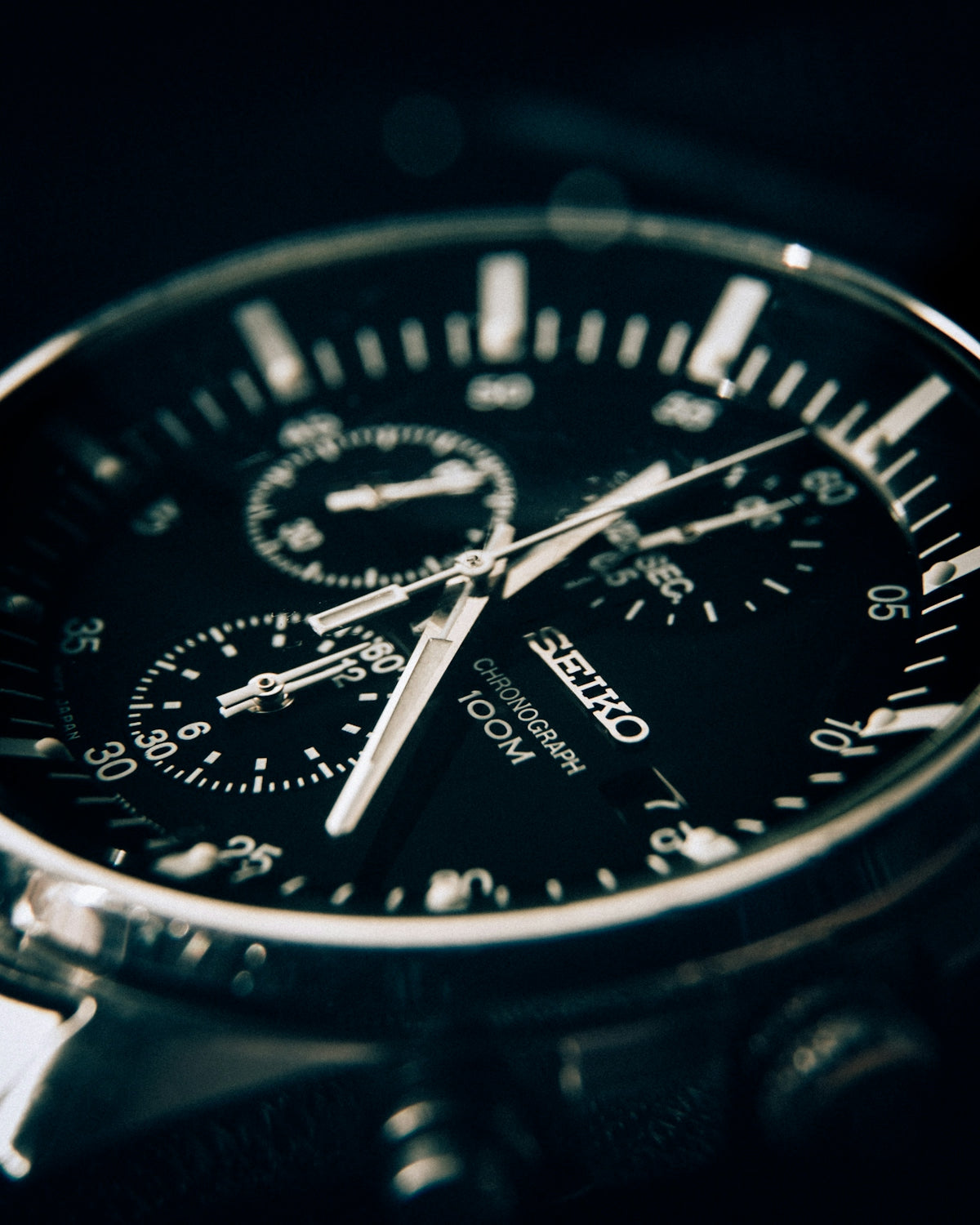
You can identify a chronograph by three visual features:
- Two pushers on the right side of the case (at 2 o'clock and 4 o'clock positions)
- Two or three subdials (small dials within the main dial)
- A tachymeter scale on the bezel or dial edge (common but not universal)
The pushers are the key identifier. Standard watches only have a crown; chronographs add pushers specifically to control the stopwatch function.
Understanding Subdial Layouts
Chronograph subdials come in several configurations, each with industry-standard names:
| Layout | Subdials | Typical Position | Common In |
|---|---|---|---|
| Bi-compax | 2 subdials | 3 and 9 o'clock | Vintage chronographs, dress chronographs |
| Tri-compax | 3 subdials | 3, 6, and 9 o'clock | Sport chronographs, racing watches |
| Panda | Light dial + dark subdials | Varies | Classic racing style |
| Reverse Panda | Dark dial + light subdials | Varies | Modern sport watches |
Most modern chronographs use tri-compax layout. For example, the SKYRIM Mod Daytona Panda ($285) features a tri-compax layout with subdials at 3, 6, and 9 o'clock—the 3 o'clock tracks 30 minutes, 9 o'clock tracks 12 hours, and 6 o'clock shows running seconds.
What Each Subdial Measures
- Running seconds subdial: Shows the watch's continuous timekeeping seconds (always moving)
- Elapsed minutes subdial: Counts minutes when chronograph is running (30 or 60 minute capacity)
- Elapsed hours subdial: Counts hours for longer timing sessions (12-hour capacity)
Important distinction: The large central seconds hand on a chronograph is NOT for regular timekeeping—it's the chronograph seconds hand that only moves when you activate the stopwatch.
What Can You Do With a Chronograph?
Beyond the racing origins, chronographs serve practical everyday timing needs:
| Use Case | How It Helps |
|---|---|
| Cooking | Time recipes, tea steeping, meat resting—without leaving the kitchen |
| Exercise | Track intervals, rest periods, running splits |
| Work | Time presentations, meetings, billable hours, parking |
| Photography | Time long exposures in manual mode |
| Productivity | Pomodoro technique, focused work sessions |
Key advantage over phone stopwatch: The chronograph timing is independent of the main time display. You can glance at your watch and see both the current time AND how long your timer has been running—no screen unlocking, no app switching.
The Tachymeter Scale
Many chronographs feature a tachymeter scale on the bezel or dial edge. This converts elapsed time into speed (units per hour).
How to use it:
- Start the chronograph when passing a mile (or kilometer) marker
- Stop when passing the next marker
- Read where the chronograph seconds hand points on the tachymeter scale
Example: If covering one mile takes 45 seconds, the tachymeter indicates 80 mph.
Today, tachymeters are primarily design elements reinforcing motorsport heritage rather than practical tools—but understanding them adds to chronograph appreciation.
How to Use a Chronograph Watch
Operating a chronograph requires understanding the three controls:
- Crown → Sets time and date (same as any watch)
- Top pusher (2 o'clock) → Starts and stops the stopwatch
- Bottom pusher (4 o'clock) → Resets stopwatch to zero
Step-by-Step Operation
- Start: Press the top pusher once. The central chronograph seconds hand begins sweeping.
- Stop: Press the top pusher again. Read elapsed time from the central hand (seconds) and subdials (minutes/hours).
- Reset: Press the bottom pusher. All chronograph hands return to zero.
Critical Rule: Stop Before Reset
Never press the reset pusher while the chronograph is running. This can damage the movement's reset mechanism. Always stop first, then reset.
Exception: Some high-end chronographs ($3,000+) feature "flyback" functionality that allows reset-while-running. The mechanism automatically stops, resets, and restarts in one pusher press—useful for timing consecutive laps. Standard chronographs do not have this feature.
Types of Chronograph Movements
Chronograph watches use three main movement types, each with distinct characteristics:
| Movement Type | Accuracy | Seconds Hand | Price Range | Service Cost | Best For |
|---|---|---|---|---|---|
| Mechanical | ±5-10 sec/day | Smooth sweep | $800-50,000+ | $300-800 | Collectors, enthusiasts |
| Meca-Quartz | ±20 sec/month | Smooth sweep | $150-500 | $50-100 | Best value, daily wear |
| Full Quartz | ±15 sec/month | Ticking steps | $50-300 | $30-60 | Budget, tool use |
Mechanical Chronographs
Traditional mechanical chronographs use complex gear trains powered entirely by a mainspring. Famous calibers include the Valjoux 7750, Zenith El Primero, and Rolex 4130.
Why they're expensive: Mechanical chronograph movements contain 100-300+ components versus 50-100 in standard automatics. Coordinating stopwatch functions through purely mechanical means requires expert engineering and assembly.
Entry points: Swiss mechanical chronographs start around $800-1,500 (Tissot, Hamilton). Established brands like Omega Speedmaster begin at $5,500+. Rolex Daytona commands $15,000+ retail.
Meca-Quartz Chronographs
Meca-quartz movements combine quartz precision with mechanical chronograph feel. The Seiko VK63 is the most common caliber in this category.
How it works:
- Quartz crystal regulates timekeeping (±20 seconds/month accuracy)
- Mechanical module controls the chronograph function
- Result: Smooth sweeping seconds hand (like mechanical) with quartz reliability
Watches like the SKYRIM Mod Daytona Black ($285, VK63 movement, ceramic bezel, 904L stainless steel) demonstrate how meca-quartz delivers the chronograph experience at accessible prices—sapphire crystal, quality construction, and that satisfying mechanical sweep.
Full Quartz Chronographs
Pure quartz chronographs use electronic modules for all functions. Accurate and affordable, but the seconds hand "ticks" in discrete steps rather than sweeping smoothly. Many enthusiasts find this less satisfying for a chronograph.
Column Wheel vs Cam-Actuated Mechanisms
Within mechanical chronographs, two systems control the start/stop/reset functions:
| Mechanism | How It Works | Feel | Cost |
|---|---|---|---|
| Column Wheel | Rotating column engages/disengages chronograph | Smooth, precise pusher action | Higher ($2,000+) |
| Cam-Actuated | Lever and cam system controls chronograph | Slightly mushier pusher feel | Lower ($500+) |
Column wheel is considered more prestigious, but cam-actuated movements (like the Valjoux 7750) are equally reliable. The difference is primarily in pusher feel and collector perception.
Note: Meca-quartz movements like the VK63 use a cam system, which keeps costs down while delivering excellent functionality.
Brief History of Chronograph Watches
Understanding chronograph history adds context to their design and value:
| Era | Development | Significance |
|---|---|---|
| 1816 | Louis Moinet creates first chronograph | Originally for tracking astronomical objects |
| 1821 | Nicolas Rieussec patents "time writer" | Ink-dropping mechanism literally wrote on dial |
| 1913 | First wrist chronograph | Aviation and military applications |
| 1930s-60s | Racing chronograph boom | Rolex Daytona, Omega Speedmaster, Heuer Carrera born |
| 1969 | First automatic chronograph | Zenith El Primero, Seiko, and Chronomatic race |
| 1980s-present | Quartz and meca-quartz development | Democratized chronograph accessibility |
The racing connection explains why chronographs often feature tachymeter scales and sport-oriented designs—they were literally born on the racetrack.
Advantages of Chronograph Watches
- ✅ Practical functionality: Built-in stopwatch without carrying a separate device
- ✅ Independent timing: Time events while still reading current time
- ✅ Visual interest: Subdials add depth and complexity to the dial
- ✅ Versatile aesthetics: Works for sport, casual, and even business settings
- ✅ Heritage appeal: Connection to racing, aviation, and space exploration history
- ✅ Conversation piece: Non-watch people notice and ask about chronographs
- ✅ Accessible options: Quality meca-quartz chronographs available under $300
Limitations to Consider
- ❌ Thicker cases: Chronograph movements add 2-4mm to case thickness
- ❌ Busier dials: Subdials reduce negative space; some find this cluttered
- ❌ Higher service costs: More components = more expensive maintenance
- ❌ Mechanical complexity: More parts mean more potential failure points
- ❌ Size creep: Chronographs typically run 40-44mm to accommodate movement
- ❌ Unused functionality: Many owners never use the chronograph function
Reality check: If you never use stopwatch functionality, a cleaner three-hand watch might serve you better. But if you appreciate the aesthetic or occasionally time things, chronographs deliver both form and function.
What to Look for When Buying a Chronograph
Movement Type
- Want prestige and tradition? → Mechanical (budget: $800+)
- Want best value and practicality? → Meca-quartz (budget: $150-500)
- Want lowest cost? → Full quartz (budget: $50-300)
Key Specifications
| Spec | Minimum Recommended | Ideal |
|---|---|---|
| Crystal | Mineral glass | Sapphire crystal |
| Water resistance | 50m (daily wear) | 100m+ (water activities) |
| Case material | 316L stainless steel | 904L stainless steel |
| Bezel | Steel or aluminum | Ceramic (scratch resistant) |
Legibility Factors
- Subdials should be clearly readable, not cramped
- Chronograph seconds hand should be visually distinct from minute hand
- Lume on hands if you need low-light readability
Example: What $285-299 Gets You
The SKYRIM Mod Daytona collection demonstrates quality chronograph construction at accessible prices:
- VK63 meca-quartz movement (smooth sweep, ±20 sec/month)
- Sapphire crystal (scratch resistant)
- Ceramic bezel (won't fade or scratch)
- 904L stainless steel case and bracelet
- 40mm case diameter
- Tri-compax subdial layout
This spec sheet would cost $1,000+ with a Swiss mechanical movement—meca-quartz makes it accessible.
Frequently Asked Questions
What's the difference between a chronograph and a stopwatch?
A stopwatch is a dedicated timing device—it only measures elapsed time. A chronograph is a watch that includes stopwatch functionality alongside regular timekeeping. With a chronograph, you can time events AND tell the current time simultaneously. With a pure stopwatch, you can only time events.
Is a chronograph the same as an automatic watch?
No. "Chronograph" refers to stopwatch functionality. "Automatic" describes how the movement is powered (self-winding via rotor). A watch can be both—an automatic chronograph—or neither. Many chronographs use quartz or meca-quartz movements rather than automatic mechanical movements.
What is a flyback chronograph?
A flyback chronograph allows you to reset and restart the stopwatch with a single pusher press, without stopping first. The mechanism automatically stops, resets to zero, and restarts instantly. This is useful for timing consecutive laps or events. Flyback is typically found only in higher-end mechanical chronographs ($3,000+).
What does "bi-compax" and "tri-compax" mean?
"Compax" refers to the number of subdials. Bi-compax has 2 subdials (usually at 3 and 9 o'clock). Tri-compax has 3 subdials (usually at 3, 6, and 9 o'clock). These terms help describe chronograph dial layouts.
Why are mechanical chronographs so expensive?
Mechanical chronograph movements contain 100-300+ components requiring precise assembly and adjustment. The complexity of coordinating stopwatch functions through purely mechanical means demands expert craftsmanship. Entry-level Swiss mechanical chronographs start around $800, while prestigious examples exceed $10,000.
Can I use a chronograph for everyday wear?
Yes. While chronographs were designed for timing applications, they function perfectly as everyday watches. You don't need to use the stopwatch function regularly—many owners appreciate chronographs purely for their aesthetic. Modern chronographs with sapphire crystal and solid construction handle daily wear well.
What is meca-quartz?
Meca-quartz combines quartz timekeeping accuracy with a mechanical chronograph module. This delivers the smooth sweeping seconds hand enthusiasts prefer (like a mechanical watch), with quartz reliability and lower cost. The Seiko VK63 is the most common meca-quartz caliber.
How often should I service a chronograph?
- Mechanical: Every 4-5 years ($300-800)
- Meca-quartz: Battery every 2-3 years ($50-100), full service less frequently
- Full quartz: Battery changes only unless problems arise
Can the chronograph run continuously?
Technically yes, but it's not recommended for extended periods. Running the chronograph continuously increases wear on the movement and drains batteries faster (for quartz/meca-quartz). Most chronographs are designed for intermittent timing use, not continuous operation.
Conclusion
A chronograph watch combines standard timekeeping with stopwatch functionality through additional pushers and subdials. The key identifiers are two pushers (at 2 and 4 o'clock) and multiple subdials tracking elapsed time.
Key takeaways:
- Chronographs let you time events without affecting regular timekeeping
- Three movement types: mechanical (prestige), meca-quartz (best value), quartz (budget)
- Always stop before reset—never reset while running (unless flyback equipped)
- Quality meca-quartz chronographs deliver excellent functionality under $300
- Subdial layouts: bi-compax (2), tri-compax (3), panda (light dial/dark subdials)
Whether timing a race, tracking a workout, or simply appreciating the mechanical complexity on your wrist, chronographs remain one of watchmaking's most practical and visually distinctive complications.


Share:
Tags:
6 Best Omega Speedmaster Alternatives: Seiko Mod Speedmaster
Arabic Dial Watches: Complete Guide to Arabic Numeral Timepieces