


A quartz movement is the engine behind roughly 90% of the world's watches. Powered by a battery and a tiny quartz crystal, it keeps time with exceptional precision—typically within 15 seconds per year. If you've ever noticed a watch with a second hand that jumps once per second in distinct ticks, you've seen a quartz movement at work.
This guide explains how quartz movements work at a technical level, covers the five distinct types available in 2026—from basic quartz to hybrid meca-quartz chronographs—and compares quartz against mechanical movements. Whether you're choosing your first watch or deciding between quartz and automatic, you'll find clear answers here.
What Is a Quartz Movement?
Definition: A quartz movement is a type of watch mechanism that uses electrical energy from a battery to vibrate a small quartz crystal at a precise frequency. These vibrations regulate the movement of the watch hands, producing highly accurate timekeeping.
The term "quartz" refers to silicon dioxide (SiO₂), a naturally occurring mineral with a unique property: when subjected to electrical current, it vibrates at an extremely consistent rate. This physical behavior—called the piezoelectric effect—makes quartz crystal ideal for regulating time.
In practical terms, a quartz watch requires minimal effort from its owner. There is no winding, no rotor to spin, and no power reserve to monitor. You wear it, and it keeps accurate time. The only routine maintenance is replacing the battery every 2 to 5 years, depending on the movement caliber and complications.
How Does a Quartz Watch Movement Work?
The process inside a quartz movement follows a precise chain of events, from battery to hands.
Step 1: Power
A silver oxide battery sends a small electrical current to an integrated circuit inside the movement.
Step 2: Vibration
The circuit directs current to a tuning-fork-shaped quartz crystal, which vibrates at exactly 32,768 Hz.
Step 3: Counting
The integrated circuit counts 32,768 oscillations and outputs one electrical pulse—once per second.
Step 4: Movement
Each pulse drives a stepping motor that advances the gear train, moving the watch hands forward.
Why 32,768 Hz?
This number is not arbitrary. 32,768 equals 2 raised to the 15th power (2¹⁵), which allows the circuit to divide the frequency down to exactly 1 pulse per second using simple binary division—each division stage halves the frequency. This mathematical elegance keeps the circuit design efficient and the manufacturing cost low.
This high vibration rate is also what makes quartz so accurate. A mechanical watch relies on a balance wheel oscillating 6 to 10 times per second. A quartz crystal oscillates 32,768 times per second. More oscillations per second mean smaller deviations from true time, which translates to far greater precision. Where a quality mechanical watch might drift 5 to 10 seconds per day, a standard quartz movement stays within ±15 seconds per year.
5 Types of Quartz Watch Movements
Not all quartz movements are the same. Five main categories exist today, each addressing a different balance of accuracy, power source, and functionality.
Standard Quartz
The most common type, found in the majority of affordable and mid-range watches. A battery powers the quartz crystal, the circuit counts vibrations, and a stepping motor drives the hands. Typical accuracy sits at ±15 to 30 seconds per year, and battery life ranges from 2 to 5 years.
Manufacturers like Seiko, Miyota, ETA, and Ronda produce millions of standard quartz calibers annually. If a watch specification lists "quartz movement" without further detail, it is almost certainly this type.
High-Accuracy Quartz (HAQ)
Standard quartz crystals speed up or slow down slightly as temperature changes. HAQ movements address this limitation by adding thermal sensors that adjust the oscillation rate in real time, achieving accuracy of ±5 to 10 seconds per year—with some calibers reaching ±1 second per year.
Notable examples include the Citizen Chronomaster A660 and Breitling SuperQuartz (caliber 73). HAQ appeals to buyers who want the best possible accuracy without the maintenance requirements of an atomic-synced watch.
Solar-Powered Quartz
Solar quartz movements replace traditional batteries with photovoltaic cells that convert light into electrical energy, stored in a rechargeable cell. A fully charged solar watch can run 6 months or more in complete darkness, and decades with regular light exposure.
Citizen's Eco-Drive and Seiko's Solar are the most established implementations. The core timekeeping mechanism remains standard quartz—solar technology only changes the power source, eliminating battery replacements entirely.
Kinetic (Auto-Quartz)
Developed by Seiko in 1988, Kinetic movements use a weighted rotor—similar to automatic mechanical watches—that spins as you move your wrist. Instead of winding a mainspring, the rotor drives a micro-generator that charges a capacitor. The timekeeping itself remains quartz-regulated.
Kinetic watches combine the convenience of no battery replacements with quartz-level accuracy. However, they have largely been overshadowed by solar technology, which achieves the same goal more simply.
Meca-Quartz (Hybrid Chronograph)
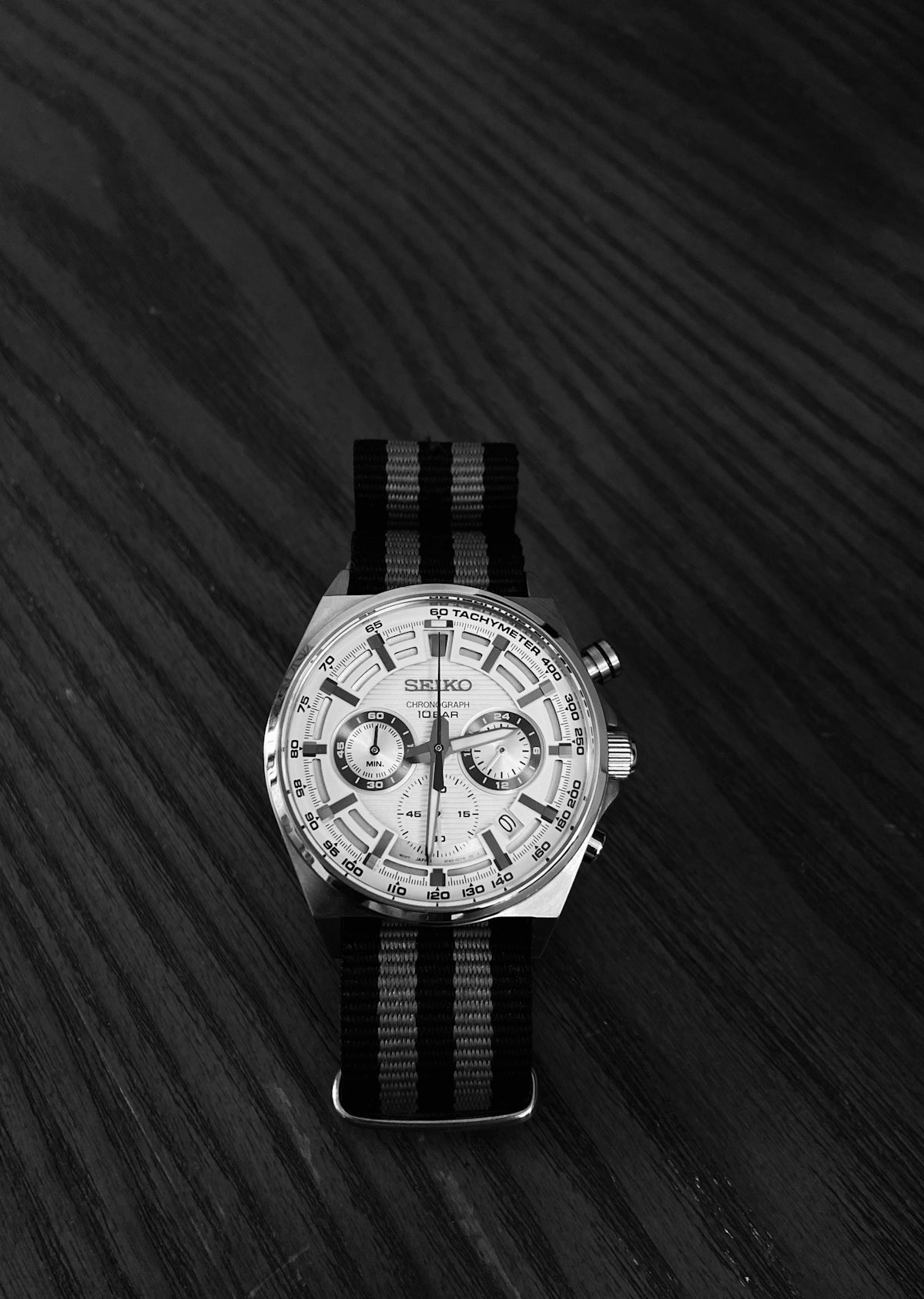
Meca-quartz represents one of the most practical innovations in modern watchmaking. The base timekeeping uses a standard quartz module for hours, minutes, and seconds. However, when you activate the chronograph function, a mechanical module powered by springs and gears drives the stopwatch hands.
The result: quartz accuracy for daily timekeeping, combined with the satisfying mechanical snap of chronograph pushers and a sweeping chronograph seconds hand. A fully mechanical chronograph movement like the ETA Valjoux 7750 costs $500 or more for the movement alone. Meca-quartz delivers comparable chronograph feel at a fraction of that cost.
Seiko's VK63 caliber is the most widely used meca-quartz movement. Brands like SKYRIM use the VK63 in their Mod Daytona chronograph series ($295, 40mm ceramic bezel) and Mod Speedmaster collection ($295, 42mm), pairing quartz precision with mechanical chronograph feel, sapphire crystals, and ceramic bezels—a combination that would otherwise require spending $2,000 or more on a fully mechanical chronograph.
Quartz vs Mechanical Watches: Key Differences
The fundamental difference is power source. A quartz movement runs on a battery. A mechanical movement stores energy in a coiled mainspring, wound either by hand (manual-wind) or by a rotor that spins with wrist movement (automatic). This core distinction creates a cascade of practical differences.
Accuracy presents the most dramatic gap. Standard quartz movements maintain ±15 seconds per year. Even the best chronometer-rated mechanical movements (COSC-certified) allow ±4 to 6 seconds per day—compounding to roughly 25 to 40 minutes of drift per year without resetting.
Maintenance cost favors quartz significantly. A battery replacement every 2 to 5 years costs $15 to $30. Mechanical movements require full servicing every 5 to 7 years, typically costing $200 to $500 depending on complexity. Over a decade, the difference reaches $500 or more.
Durability differs in nature rather than degree. Quartz movements tolerate impacts and temperature changes better because they contain fewer delicate moving parts. Mechanical movements are more susceptible to magnetism and physical shock.
The intangible factor: many watch enthusiasts prefer mechanical movements for the craftsmanship visible through exhibition casebacks, the sweeping seconds hand, and the feeling of wearing a miniature machine. Quartz watches offer practicality without demanding that kind of emotional investment.
| Feature | Quartz | Mechanical (Automatic) |
|---|---|---|
| Accuracy | ±15 sec/year | ±5–10 sec/day |
| Power Source | Battery | Mainspring (wrist motion) |
| Service Interval | Battery every 2–5 years (~$20) | Full service every 5–7 years (~$300+) |
| Second Hand | Tick (once per second) | Smooth sweep |
| Case Thickness | Typically thinner | Typically thicker |
| Shock Tolerance | Higher | More delicate |
| Price Range | $50–$5,000+ | $200–$50,000+ |
| Collecting Value | Generally lower | Generally higher |
The easiest way to identify a quartz watch: look at the second hand. If it ticks once per second in discrete jumps, it's quartz. If it sweeps smoothly, it's mechanical.
A Brief History of Quartz Movements
The story of quartz timekeeping begins in 1927 at Bell Telephone Laboratories, where engineers Warren Marrison and J.W. Horton built the first quartz clock. It was the size of a room and far too large for personal use, but it proved that quartz crystals could regulate time more accurately than any existing method.
For four decades, quartz clocks remained large and expensive, confined to laboratories and observatories. The breakthrough came on December 25, 1969, when Seiko released the Astron—the world's first quartz wristwatch. Priced at 450,000 yen (equivalent to a small car at the time), it demonstrated that quartz timekeeping could fit on a wrist.
What followed reshaped the entire watch industry. By the mid-1970s, affordable quartz watches flooded the market, particularly from Japanese manufacturers. Swiss watchmakers, who had dominated the industry for centuries with mechanical movements, faced an existential threat. This period—known as the Quartz Crisis (or Quartz Revolution, depending on perspective)—nearly destroyed traditional Swiss watchmaking. Hundreds of Swiss watch companies closed between 1970 and 1985.
The industry eventually stabilized. Mechanical watches repositioned as luxury and artisan goods, while quartz became the default for everyday timekeeping. Today, approximately 90% of all watches produced worldwide use quartz movements—a dominance that shows no sign of fading.
Quartz Movement Advantages and Disadvantages
Where Quartz Excels
Precision is the defining advantage. A ±15 seconds per year deviation means you might adjust your watch once or twice annually. For professionals who rely on punctuality—medical staff, business travelers, athletes—quartz delivers dependable accuracy without daily monitoring or resetting.
Low maintenance reduces long-term ownership cost. Battery replacements every 2 to 5 years cost $15 to $30 at most service centers. Over a decade, quartz maintenance totals roughly $40 to $90. A mechanical watch serviced twice in the same period costs $400 to $1,000. That difference can fund an entirely separate watch purchase.
Thinner profiles are possible because quartz movements contain fewer components. For dress watches and everyday wear, this means a watch that sits closer to the wrist and slides under shirt cuffs without catching.
Shock resistance comes naturally from having fewer delicate parts. The impacts of daily life—doorframes, gym equipment, desk edges—pose less risk to a quartz movement than to a mechanical one.
Where Quartz Falls Short
Battery dependence means your watch will stop when the cell dies. Most watches give no advance warning, though some quartz calibers include an end-of-life indicator where the second hand begins jumping in 2-second intervals—a signal that the battery needs replacement soon.
Collectibility and resale value remain limited. The watch collecting market overwhelmingly favors mechanical movements for their craftsmanship and heritage. A quartz watch, regardless of brand, rarely appreciates in value the way a well-maintained mechanical piece can.
The emotional connection is harder to establish. There is no visible heartbeat through an exhibition caseback, no sweeping seconds hand, and no sense of wearing a hand-assembled mechanism. For some buyers, these intangible qualities matter more than precision or low maintenance costs.
How to Choose Between Quartz and Mechanical
The right movement type depends on what you value most in a watch.
Choose Quartz If
Accuracy and convenience are your priorities. You want a watch that keeps reliable time, requires minimal attention, and fits a moderate budget. Quartz is the practical choice for a daily-wear watch, a travel companion, or a first-time buyer still exploring preferences.
Choose Mechanical If
Craftsmanship and the sensory experience drive your interest. You appreciate visible gear trains, sweeping hands, and the tradition of horology. You accept lower accuracy and higher maintenance costs in exchange for wearing something genuinely mechanical.
Consider Meca-Quartz for the Best of Both
Hybrid movements like the Seiko VK63 combine quartz precision for everyday timekeeping with a mechanical chronograph module that delivers the tactile pusher click and sweeping chronograph hand of a traditional stopwatch. SKYRIM's Mod Daytona and Mod Speedmaster chronograph collections pair VK63 meca-quartz with sapphire crystals, ceramic bezels, and hand-assembled quality—offering a practical middle ground between pure quartz simplicity and fully mechanical chronograph complexity.
Neither movement type is objectively superior. Quartz wins on precision and practicality. Mechanical wins on craftsmanship and emotional appeal. Many experienced collectors own both types for different occasions—and meca-quartz for when they want functional chronograph capability without the mechanical price premium.
Quartz Movement FAQ
Conclusion
A quartz movement converts electrical energy and crystal vibrations into precise timekeeping. It is the most common watch movement in the world, and for good reason—reliable, accurate, and accessible across every price point from $50 to $5,000.
Understanding the five types—standard quartz, HAQ, solar, kinetic, and meca-quartz—helps you match a watch to your actual needs rather than choosing blindly. Each type addresses a specific balance of convenience, precision, and functionality.
The quartz versus mechanical decision ultimately comes down to personal priorities. If you want a watch that simply works with minimal attention, quartz delivers. If you value the craft and tradition of mechanical horology, that path has its own rewards. And if you want chronograph capability without mechanical complexity, meca-quartz offers a practical middle ground.
Share:
Tags:
Where to Buy Seiko Mod Watches: 2026 Buyer's Guide
Seiko Mod Wimbledon Dial: What It Is and Why It's So Popular