


Quick Answer: The VK63 and VK64 are meca-quartz chronograph movements that differ primarily in subdial layout: VK63 uses 3-6-9 configuration (running seconds at 6 o'clock, 60-minute counter at 9 o'clock, 24-hour indicator at 3 o'clock) ideal for Daytona-style racing chronographs, while VK64 uses 6-12 configuration (running seconds at 6 o'clock, 60-minute and 12-hour counters at 12 o'clock) suited for Speedmaster-style layouts.
Both movements deliver identical core performance—±20 seconds monthly accuracy, 3-4 year battery life, mechanical chronograph feel with instant reset, and quartz timekeeping reliability. The VK63 typically includes date display at 4:30 position; VK64 offers both date and no-date variants. Neither movement is objectively "better"—designers choose based on desired dial aesthetics. VK63 dominates affordable chronograph watches ($100-300) due to widespread Daytona homage popularity, while VK64 appears in Speedmaster alternatives and vintage-inspired builds.

What is Meca-Quartz? Understanding Hybrid Technology
Before comparing VK63 and VK64 specifically, understanding meca-quartz hybrid technology explains why these movements appeal to chronograph buyers seeking both accuracy and mechanical feel.
The Hybrid Architecture
Quartz timekeeping module: The main hour, minute, and seconds hands (and date mechanism if equipped) run on traditional quartz technology. A battery powers a quartz crystal oscillating at 32,768 Hz, providing ±20 seconds monthly accuracy—roughly 60 times more accurate than mechanical automatic movements.
Mechanical chronograph module: The chronograph complication—start/stop/reset functions and all subdials—operates through purely mechanical construction. Springs, gears, levers, and hammers create the chronograph operation exactly as traditional mechanical chronographs do.
Why hybrid? Fully mechanical chronographs cost $300-5000 due to complex movement construction and labor-intensive assembly. Fully quartz chronographs cost $20-200 but suffer from stuttering chronograph hands (advancing in 1/5 or 1/10 second increments) and mushy push-feel lacking mechanical feedback. Meca-quartz combines quartz accuracy and affordability with mechanical chronograph feel—smooth sweeping chronograph hand (4 beats per second) and crisp pusher action with satisfying clicks.
The Seiko VK Advantage
Seiko pioneered meca-quartz chronograph movements in the 1980s and remains the dominant supplier. The VK-series (VK63, VK64, VK67, VK83, etc.) represents current-generation meca-quartz calibers offering:
Proven reliability: 3-4 year battery life versus 2-3 years for fully quartz movements. The mechanical chronograph module requires no battery power except when actively timing—only the base timekeeping drains the battery continuously.
Serviceability: Replaceable batteries cost $10-20 installed. If the chronograph module fails, watchmakers can replace the entire VK movement for $60-100—far cheaper than servicing traditional mechanical chronographs ($300-800).
Accuracy maintenance: Quartz timekeeping doesn't degrade over time. A 10-year-old VK63 maintains ±20 seconds monthly accuracy identical to brand new movements. Mechanical chronographs gradually lose accuracy as lubricants dry, requiring expensive service every 5-7 years.

VK63 Complete Specifications
The VK63 movement dominates affordable chronograph watches due to its Daytona-compatible subdial layout.
Technical Specifications
Caliber: VK63A (also designated VK63)
Movement type: Meca-quartz hybrid (quartz timekeeping + mechanical chronograph)
Dimensions: 30.8mm diameter × 29.1mm width × 5.1mm height
Frequency: 32,768 Hz (quartz crystal standard)
Accuracy: ±20 seconds per month (approximately ±5 seconds per week)
Battery: SR936SW / 394 cell, 3-4 year lifespan
Chronograph accuracy: 1/4 second resolution (4 beats per second)
Maximum chronograph time: 60 minutes
Subdial Layout (3-6-9 Configuration)
6 o'clock position: Running seconds—continuously rotates once per minute during normal operation. This provides visual confirmation the watch is running.
9 o'clock position: 60-minute chronograph counter—advances one increment each minute while chronograph runs. Enables timing events up to one hour.
3 o'clock position: 24-hour indicator—rotates once per 24 hours, showing AM/PM and current hour on 24-hour scale. Not a chronograph function; purely informational.
Date window: Typically positioned at 4:30 between 3 and 6 o'clock subdials. Date advances at midnight with quickset capability through crown positions.
Why 3-6-9 Configuration Matters
The VK63's subdial layout directly mirrors the Rolex Daytona (and Omega Speedmaster to lesser extent), making it ideal for homage watches. The 3-6-9 symmetry creates balanced dial aesthetics—three subdials distributed evenly around the dial create visual harmony. Racing chronographs particularly favor this layout as it matches motorsport timing heritage.

VK64 Complete Specifications
The VK64 movement offers alternative subdial configuration suited for different chronograph aesthetics.
Technical Specifications
Caliber: VK64A (also designated VK64)
Movement type: Meca-quartz hybrid (identical hybrid architecture to VK63)
Dimensions: 30.8mm diameter × 29.1mm width × 5.1mm height (identical to VK63)
Frequency: 32,768 Hz
Accuracy: ±20 seconds per month
Battery: SR936SW / 394 cell, 3-4 year lifespan
Chronograph accuracy: 1/4 second resolution (4 beats per second)
Maximum chronograph time: 12 hours (60 minutes + 12-hour counter)
Subdial Layout (6-12 Configuration)
6 o'clock position: Running seconds—identical function to VK63, continuously rotating to confirm watch operation.
12 o'clock position: Dual counter—combines 60-minute chronograph counter (inner track) with 12-hour chronograph counter (outer track or separate indicator). This enables timing extended events beyond 60 minutes up to 12 hours total.
3 o'clock position (if equipped): Date window—VK64 offers both date and no-date variants. Date models position window at 3 o'clock; no-date models omit this complication entirely for cleaner dial symmetry.
Why 6-12 Configuration Matters
The VK64's vertical subdial arrangement creates different visual balance. The 12 o'clock subdial adds 12-hour chronograph capability lacking in VK63—useful for timing events exceeding one hour (long-distance driving, cooking, multi-stage processes). The layout suits Speedmaster-style chronographs and vintage racing chronograph reissues where vertical subdial arrangement matches historical designs.
VK63 vs VK64: Direct Comparison
Choosing between VK63 and VK64 depends entirely on aesthetic preferences and chronograph timing needs—technical performance remains identical.
Detailed Comparison Table
| Feature | VK63 | VK64 |
|---|---|---|
| Subdial Layout | 3-6-9 configuration | 6-12 configuration |
| Running Seconds | 6 o'clock | 6 o'clock |
| 60-Minute Counter | 9 o'clock | 12 o'clock (inner) |
| 12-Hour Counter | None | 12 o'clock (outer/separate) |
| 24-Hour Indicator | 3 o'clock | None |
| Date Display | Standard (4:30 position) | Optional (3 o'clock or none) |
| Max Timing | 60 minutes | 12 hours |
| Accuracy | ±20 sec/month | ±20 sec/month |
| Battery Life | 3-4 years | 3-4 years |
| Dimensions | 30.8×29.1×5.1mm | 30.8×29.1×5.1mm |
| Chronograph Feel | Mechanical (4 bps sweep) | Mechanical (4 bps sweep) |
| Movement Cost | $50-70 | $55-75 |
| Ideal For | Daytona homages, racing chronographs | Speedmaster alternatives, extended timing |
Key Decision Factors
Choose VK63 if you want:
- Daytona-style 3-6-9 subdial symmetry
- 24-hour indicator for AM/PM confirmation
- Standard date display at 4:30
- Maximum 60-minute timing (sufficient for most uses)
- Racing chronograph aesthetics
- Most common configuration (wider parts compatibility)
Choose VK64 if you want:
- Speedmaster-style 6-12 vertical subdial layout
- 12-hour chronograph capability (extended timing)
- No-date option for cleaner dial symmetry
- Vintage chronograph proportions
- Distinctive layout differentiating from common Daytona homages
What's Identical Between VK63 and VK64
Despite subdial differences, the movements share fundamental capabilities:
Chronograph operation: Both use mechanical modules with identical pusher feel, sweep rate (4 beats per second), and instant-reset functionality. The satisfying click when engaging chronograph, the smooth sweeping seconds hand, and the instant snap-back to zero feel identical.
Accuracy: ±20 seconds monthly performance comes from the same quartz timekeeping module. Neither movement runs more accurately than the other.
Reliability: Both movements last 3-4 years per battery and survive similar lifespan (10-20+ years with battery replacement). Failure rates remain statistically identical.
Service costs: Battery replacement costs $10-20 for both. Movement replacement costs $60-100 for both. No financial advantage exists choosing one over the other.
Case compatibility: Identical movement dimensions mean both fit the same cases. Designers choose VK63 or VK64 based purely on dial layout preference, not case engineering constraints.
Watches Using VK63 and VK64 Movements
Understanding real-world applications helps contextualize which movement suits specific watch styles.
VK63 Applications
Daytona homages: The 3-6-9 subdial layout makes VK63 the default choice for Rolex Daytona alternatives. Brands like Pagani Design, Sugess, Addiesdive, and dozens of microbrands use VK63 in sub-$300 racing chronographs.
Speedmaster alternatives (some): While Speedmaster uses different subdial configuration originally, many affordable Speedmaster alternatives use VK63 due to its popularity and parts availability. The SKYRIM Mod Speedmaster Fuji Redline ($280) uses VK63 meca-quartz, combining Speedmaster aesthetics with racing chronograph functionality through ceramic bezel, sapphire crystal, and Japanese-inspired colorway.
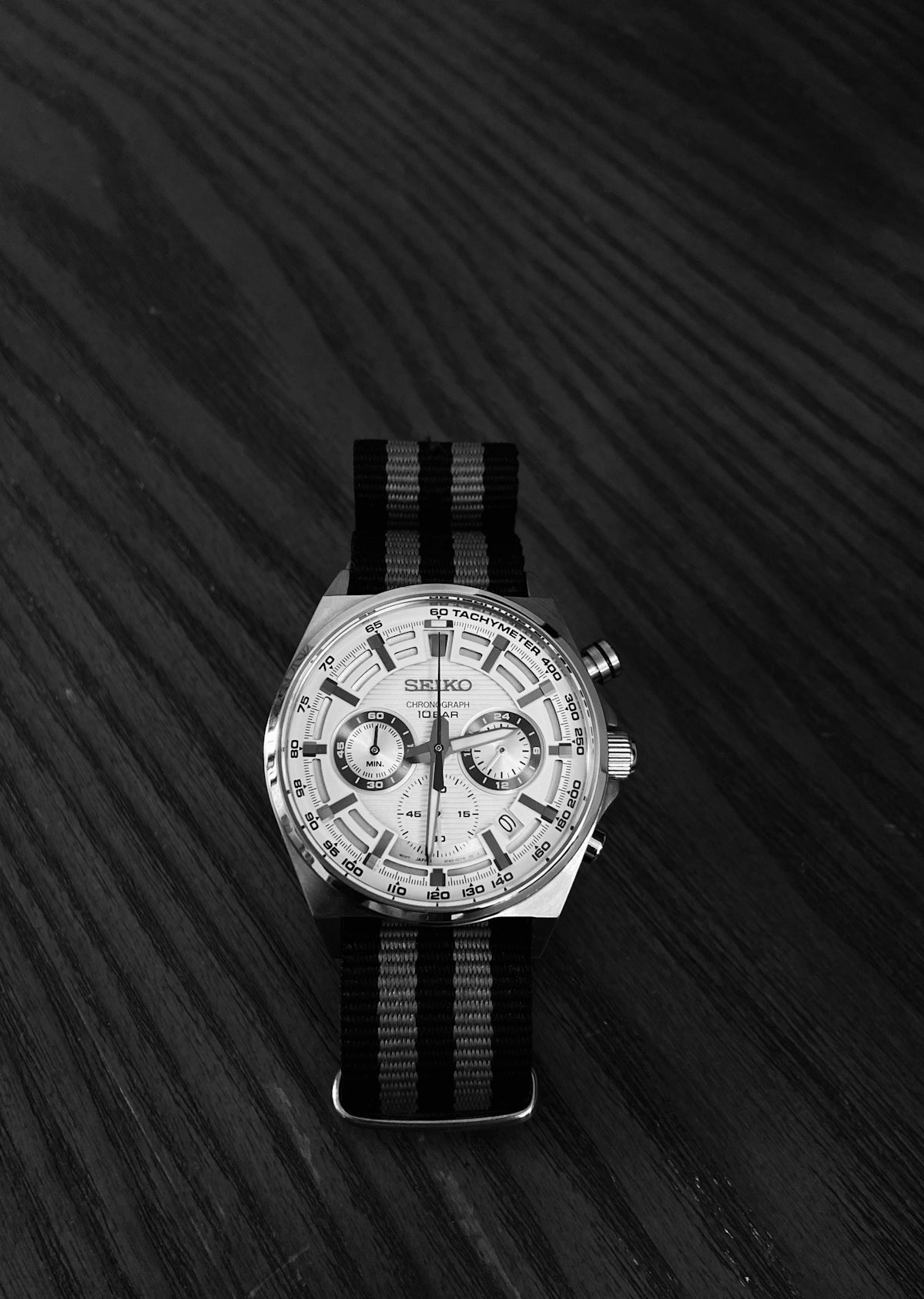
Racing chronographs: Any watch emphasizing motorsport heritage—tachymeter bezels, panda dials, racing stripes—typically uses VK63 for authentic racing chronograph subdial layout.
Budget chronographs: The VK63's widespread use creates economies of scale. Watches using VK63 range from $80 (basic Chinese brands) to $400 (premium microbrands), with performance differences coming from case quality and finishing rather than movement capability.
VK64 Applications
Speedmaster alternatives: The vertical 6-12 subdial arrangement better matches Speedmaster Professional's original layout, making VK64 preferred for authentic Speedmaster homages prioritizing dial accuracy.
Vintage chronograph reissues: Many 1960s-1970s chronographs used vertical subdial configurations. VK64 enables vintage-correct reissues with modern quartz accuracy.
Tool watches needing 12-hour timing: Professional applications requiring extended chronograph use (aviation, marine, industrial timing) benefit from VK64's 12-hour maximum versus VK63's 60-minute limit.
No-date minimalist chronographs: VK64's no-date variant creates cleaner dial symmetry than VK63 (which typically includes date). Minimalist chronograph builds favor VK64 for this option.
Aftermarket Modding Considerations
VK63 parts ecosystem: More extensive dial, hand, and case selection exists for VK63 due to its popularity. Finding VK63-compatible parts requires less searching than VK64 alternatives.
VK64 specialty builds: The vertical subdial layout suits specific aesthetic visions but requires dials explicitly designed for VK64. Generic "3-6-9" dials don't accommodate VK64's 6-12 configuration.
Custom dial makers: Services creating custom chronograph dials can produce VK63 or VK64 configurations. Specify your movement choice before ordering—subdial positions aren't interchangeable.
Meca-Quartz vs Mechanical: When to Choose Each
Understanding where meca-quartz fits in the chronograph landscape helps determine whether VK63/VK64 suit your needs versus mechanical alternatives.
Meca-Quartz Advantages (VK63/VK64)
Accuracy: ±20 seconds monthly crushes mechanical chronographs' ±20-30 seconds daily. You'll adjust meca-quartz watches once per month versus daily/weekly for mechanical.
Maintenance: Battery replacement every 3-4 years ($10-20) versus full service every 5-7 years ($300-800) for mechanical chronographs.
Cost: Complete VK63/VK64 watches range $80-400 versus $500-5000+ for mechanical chronograph alternatives with comparable specifications.
Reliability: Fewer components mean fewer failure points. Meca-quartz movements rarely experience catastrophic failure—battery dies predictably, movement replacement costs $60-100 if needed.
Thickness: VK movements enable slimmer chronograph cases (5.1mm movement height) versus mechanical chronographs (6-8mm typical height).
Mechanical Chronograph Advantages
No batteries: Automatic or hand-wound mechanical movements never need battery replacement. Daily winding or wearing keeps them running indefinitely.
Prestige and romance: Fully mechanical chronographs carry horological prestige meca-quartz can't match. The complexity, craftsmanship, and tradition appeal to collectors.
Heirloom potential: Mechanical chronographs become family heirlooms spanning generations. Meca-quartz movements eventually become unrepairable when replacement parts cease production.
Smooth sweep: High-beat mechanical chronographs (28,800 vph) create smoother sweep than meca-quartz's 4 beats per second. However, most observers can't distinguish the difference during normal wear.
The Honest Assessment
Meca-quartz excels for practical chronograph users who actually time events, appreciate accuracy, and prefer low-maintenance watches. Mechanical chronographs excel for collectors valuing craftsmanship, tradition, and prestige over practical advantages. Neither choice is wrong—they serve different priorities.
For daily-wear chronographs under $500, meca-quartz delivers superior value proposition. For watch collections emphasizing mechanical heritage and long-term collecting, mechanical movements justify premium pricing despite practical compromises.
Frequently Asked Questions
Which is better: VK63 or VK64?
Neither—they're functionally identical with different subdial layouts. Choose VK63 for 3-6-9 configuration (Daytona-style), VK64 for 6-12 configuration (Speedmaster-style). Performance, accuracy, reliability, and cost remain identical. The "better" choice depends purely on your aesthetic preference.
How long do VK63 and VK64 batteries last?
3-4 years typical lifespan under normal use. Frequent chronograph use slightly reduces battery life (the mechanical chronograph drains minimal power when running), but most users achieve 3+ years. Battery replacement costs $10-20 at any jeweler or watch shop. Use SR936SW / 394 battery cells.
Are meca-quartz movements reliable?
Yes—meca-quartz reliability exceeds fully mechanical chronographs. The quartz timekeeping module rarely fails (decades of service life), and the mechanical chronograph module uses simple, proven construction. Seiko VK movements regularly operate 10-20 years with only battery replacement. If failure occurs, complete movement replacement costs $60-100 versus $300-800 for mechanical chronograph service.
Can I time events longer than 60 minutes with VK63?
No—VK63's chronograph maxes at 60 minutes, then the counter returns to zero. For extended timing, choose VK64 with 12-hour chronograph capability, or use mechanical chronographs with 12-hour counters. However, 60 minutes suffices for 95% of real-world timing applications—few people actively time events exceeding one hour.
Do VK movements feel like mechanical chronographs?
The chronograph operation feels mechanical—smooth 4-beat-per-second sweep, crisp pusher engagement, instant reset snap. The difference from fully mechanical: the main seconds hand ticks once per second (quartz characteristic) rather than sweeping smoothly. Chronograph enthusiasts accept this trade-off for superior accuracy and lower maintenance.
Conclusion: Choose Based on Dial Layout, Not Performance
The VK63 vs VK64 decision represents one of the rare watch choices driven purely by aesthetics rather than technical superiority. Both movements deliver identical accuracy (±20 seconds monthly), identical reliability (3-4 year battery life), identical chronograph feel (mechanical 4-beat sweep), and identical service costs ($10-20 battery replacement). Neither runs more accurately, neither lasts longer, neither feels more refined during operation.
Choose VK63 if you're building Daytona-style racing chronographs or want the most common configuration with extensive parts availability. The 3-6-9 subdial symmetry creates balanced racing chronograph aesthetics, the 24-hour indicator adds practical AM/PM confirmation, and the widespread use ensures replacement dials, hands, and complete movements remain readily available.
Choose VK64 if you're creating Speedmaster alternatives, need 12-hour chronograph timing, or want vertical subdial aesthetics differentiating from ubiquitous Daytona homages. The 6-12 configuration suits vintage chronograph reissues and tool watches requiring extended timing capability beyond 60 minutes.
The beauty of meca-quartz: you're not choosing between better and worse, premium and budget, or prestigious and practical. You're simply choosing which subdial layout suits your watch design vision. Both movements deliver the core meca-quartz promise—mechanical chronograph feel with quartz accuracy and affordability—making either choice a winning decision for practical chronograph buyers prioritizing function over horological romanticism.

Share:
Tags:
10 Best GMT Watches Under $1000 in 2025 for Every Budget
What is the Most Iconic Seiko Watch of All Time?